Hardwood Plywood vs MDF for Cabinet Manufacturing: Key Differences and How to Choose
November 24, 2026
When selecting panel materials for cabinet manufacturing, hardwood plywood and MDF serve different production and performance requirements. Hardwood plywood is generally preferred when structural strength, screw holding, and reduced panel weight are important, while MDF is often selected for its smooth, uniform surface and suitability for painted finishes.
However, neither material is automatically the better choice for every cabinet component. Buyers should evaluate the intended application, hardware requirements, surface finish, moisture exposure, machining process, and total production cost before placing an order.
This guide compares hardwood plywood vs MDF from a cabinet manufacturer’s perspective and explains how to specify the right panel material for different furniture applications.
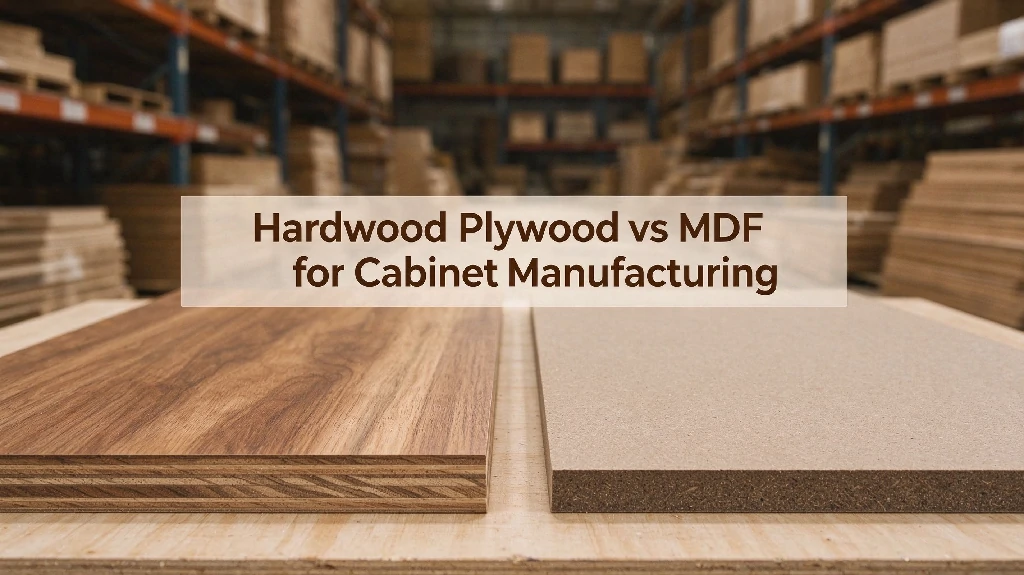
1. What Is the Difference Between Hardwood Plywood and MDF?
Hardwood plywood is an engineered wood panel made by bonding multiple layers of wood veneer together, usually with adjacent layers arranged with alternating grain directions. A hardwood face veneer provides the visible surface, while the internal construction contributes to the panel’s structural properties.
MDF, or medium-density fiberboard, is manufactured from refined wood fibers combined with resin and formed into a dense, uniform panel under heat and pressure. Unlike plywood, MDF does not contain cross-laminated veneer layers.
The main difference is their internal construction. Plywood relies on layered wood veneers, whereas MDF uses compressed wood fibers. This affects their mechanical behavior, weight, edge characteristics, fastening performance, and finishing requirements.
| Comparison factor | Hardwood plywood | MDF |
|---|---|---|
| Core construction | Cross-laminated wood veneers | Compressed wood fibers |
| Surface | Depends on face veneer and grade | Smooth and uniform |
| Screw holding | Generally suitable for many mechanical fastening applications; depends on construction | Requires suitable screws and edge-fastening design |
| Strength characteristics | Depends on species, veneer layers, thickness, and bonding | Depends on density, thickness, and panel grade |
| Weight | Varies by species and core construction | Varies by density and panel specification |
| Edge finishing | Exposed veneer layers may require edge treatment | Smooth machined edges, but sealing is often necessary |
| Painted finishes | Requires suitable surface preparation | Often suitable for smooth painted finishes |
| Moisture response | Depends on adhesive, veneer, and panel construction | Can swell when exposed to moisture |
| Typical applications | Cabinet carcasses, shelves, furniture structures, doors | Painted doors, decorative components, interior furniture |
Important: Actual performance cannot be determined by material name alone. Buyers should compare technical specifications and test results for the specific panel grades being considered.
2. Strength and Screw Holding: Which Material Is Better for Cabinet Structures?
Cabinet components often need to support shelves, hinges, drawer slides, handles, and other hardware. Their performance depends not only on panel strength but also on fastening locations, load distribution, panel thickness, and installation methods.
Hardwood Plywood for Structural Cabinet Components
Hardwood plywood uses layered veneer construction to distribute loads across the panel. Its cross-laminated structure can provide a useful balance of stiffness and strength for cabinet sides, shelves, partitions, and other furniture components.
For manufacturers, screw holding is particularly important around hinge plates, connecting fittings, and hardware mounting points. However, plywood quality varies with veneer thickness, core composition, internal voids, bonding quality, and manufacturing consistency.
When evaluating hardwood plywood, buyers should confirm:
- Core construction and veneer quality
- Panel thickness and thickness tolerance
- Internal voids and core gaps
- Screw-holding requirements for the intended hardware
- Flatness and bonding quality
MDF for Cabinet Doors and Decorative Components
MDF provides a consistent fiber structure that supports detailed machining, routing, and shaped profiles. It is frequently considered for painted cabinet doors, decorative panels, and components that require a uniform surface.
For mechanical assembly, manufacturers should pay attention to edge fastening and hardware installation. Screw selection, pilot-hole preparation, edge distance, and fastening design can all influence the final result.
Selection guidance: For cabinet carcasses and components requiring repeated mechanical fastening, hardwood plywood is often a practical option. For routed, shaped, and painted decorative components, MDF may offer manufacturing advantages.
3. Surface Quality and Finishing Requirements
Surface appearance is a major consideration in kitchen cabinets, wardrobes, office furniture, and commercial interiors.
Hardwood plywood is commonly selected when the project requires a natural wood appearance. Its visible face depends on the selected wood species, veneer grade, grain pattern, and matching method.
For example, manufacturers may choose white oak or maple face veneers according to the desired furniture appearance. Buyers can explore White Oak Veneer Plywood and Maple Veneer Plywood for species-specific options.
MDF is often considered when a smooth, consistent substrate is required for paint or other surface treatments. It can also be machined into decorative profiles without exposing alternating veneer layers.
However, the finishing process should account for the material’s characteristics:
- Hardwood plywood: Check face veneer grade, grain consistency, sanding quality, veneer matching, and surface defects.
- MDF: Check surface smoothness, edge preparation, primer compatibility, and moisture protection.
- Both materials: Confirm that the selected panel is compatible with the intended coating, laminate, adhesive, or decorative finish.
For a deeper understanding of face quality and panel selection, see our Hardwood Plywood Grades Explained.
4. Moisture Resistance and Cabinet Applications
Moisture exposure should be considered before selecting either material.
Standard MDF can absorb moisture and swell, particularly when exposed through unsealed edges or damaged surfaces. Moisture-resistant MDF grades are available, but their performance depends on the product specification and should not be interpreted as waterproof performance.
Hardwood plywood also varies in moisture resistance. The adhesive system, veneer quality, panel construction, edge sealing, and intended service conditions all matter.
For kitchen cabinets, bathroom furniture, laundry-room storage, and other environments where humidity may fluctuate, buyers should confirm:
- The panel’s moisture-related performance specification.
- The adhesive and bonding requirements.
- Whether the product is suitable for the intended interior environment.
- Whether exposed edges need sealing.
- Whether the finished assembly provides adequate protection against moisture.
Neither hardwood plywood nor MDF should be treated as automatically waterproof. The complete furniture assembly, including joints, coatings, edges, and installation conditions, determines how well the finished product performs.
5. Cost Comparison: Material Price vs Total Manufacturing Cost
Comparing hardwood plywood and MDF based only on price per sheet can lead to an incomplete purchasing decision.
The total cost of a cabinet component includes material cost, processing efficiency, finishing, hardware installation, handling, and potential rework.
| Cost factor | Hardwood plywood | MDF |
|---|---|---|
| Material price | Depends on wood species, face grade, core, and thickness | Depends on density, grade, and thickness |
| Surface preparation | May require veneer inspection and finishing preparation | May require sealing, priming, and edge preparation |
| Machining | Requires suitable cutting tools and veneer-aware processing | Suitable for routing and detailed profiling with appropriate tooling |
| Edge treatment | May require edge banding or exposed-edge finishing | Often requires edge sealing or edge banding |
| Hardware installation | Depends on core quality and fastening design | Requires attention to edge fastening and hardware specifications |
| Transportation | Depends on actual panel density and dimensions | Depends on actual panel density and dimensions |
| Production waste | Influenced by veneer quality and cutting yield | Influenced by machining layout and edge quality |
A lower-priced panel may not produce the lowest finished-product cost if it creates additional finishing work, machining waste, or assembly problems.
For volume production, buyers should request samples and conduct trial processing before confirming a large order.
6. Which Material Should You Choose for Different Cabinet Components?
The best material depends on the function of each component rather than the furniture product as a whole.
| Cabinet component | Common material consideration | Key purchasing priority |
|---|---|---|
| Cabinet carcasses | Hardwood plywood or MDF, depending on design | Structural performance and assembly |
| Cabinet sides | Hardwood plywood for many structural applications | Flatness, thickness, and fastening |
| Painted cabinet doors | MDF is often considered | Smoothness and machining quality |
| Natural wood veneer doors | Hardwood plywood | Face veneer appearance and consistency |
| Shelves | Hardwood plywood or MDF | Load, span, thickness, and deflection |
| Drawer components | Depends on construction and hardware | Joint strength and fastening |
| Decorative panels | MDF or decorative hardwood plywood | Surface appearance and finish compatibility |
| Commercial display units | Depends on design and production volume | Durability, appearance, and manufacturing efficiency |
For example, a kitchen cabinet manufacturer may use hardwood plywood for carcasses and shelves while selecting MDF for painted decorative doors. This mixed-material approach can balance structural requirements, appearance, and production efficiency.
7. What Should Buyers Confirm Before Ordering?
Before purchasing hardwood plywood or MDF for cabinet manufacturing, buyers should prepare a clear technical specification.
Material and construction
- Panel type and core construction
- Wood species and face veneer grade, where applicable
- Panel thickness and dimensional tolerances
- Required density or mechanical performance
Surface and processing
- Surface quality and acceptable defects
- Veneer matching or grain requirements
- Sanding and finishing requirements
- Cutting, drilling, routing, and edge-banding requirements
Performance
- Intended cabinet component and load conditions
- Fastener and hardware requirements
- Moisture exposure and edge protection
- Bonding and relevant emissions documentation
Order and quality control
- Sheet dimensions and order quantity
- Sample approval before mass production
- Packaging and shipping requirements
- Inspection criteria and acceptable tolerances
Buyers evaluating hardwood plywood can also consult our Decorative Hardwood Plywood Buying Guide for additional purchasing considerations.
8. Frequently Asked Questions
Is hardwood plywood stronger than MDF?
Hardwood plywood generally offers advantages in certain structural and fastening applications because of its layered veneer construction. However, actual strength depends on panel grade, thickness, species, core quality, and manufacturing specifications. MDF performance also varies by density and product grade.
Is MDF better than plywood for painted cabinets?
MDF is often preferred for painted cabinet doors and decorative components because it provides a smooth, uniform surface and supports detailed machining. Hardwood plywood may be more suitable when the design requires a natural wood face or particular structural characteristics.
Which material holds screws better?
Hardwood plywood is generally suitable for many screw-fastening applications, but performance depends on core construction and screw placement. MDF can also be used with appropriate fasteners and assembly design. Buyers should test the actual panel and hardware combination.
Can hardwood plywood be used for kitchen cabinets?
Yes. Hardwood plywood is commonly used for cabinet sides, carcasses, shelves, and doors. The appropriate grade and construction should be selected according to load requirements, moisture exposure, surface finish, and intended service conditions.
Is moisture-resistant MDF waterproof?
No. Moisture-resistant MDF is designed for specified moisture-related conditions, but it is not automatically waterproof. Edge sealing, surface finishing, installation, and exposure conditions remain important.
9. Final Recommendation
Hardwood plywood and MDF are not direct substitutes in every cabinet manufacturing application. Hardwood plywood is often a suitable choice for structural components, natural wood finishes, and applications where fastening performance matters. MDF is frequently considered for painted doors, routed profiles, and components that require a smooth, consistent surface.
For manufacturers, the most effective approach is to match each panel material to the component’s function, production process, and performance requirements. Comparing samples, technical specifications, and total processing costs can help reduce material waste and improve purchasing decisions.
Explore Hardwood Plywood Options from Voyage
Voyage supplies hardwood plywood products for international building materials and furniture-related markets. Buyers can review available panel options, discuss face veneer and core requirements, and confirm product specifications according to their project needs.
Explore our Hardwood Plywood Sheets or contact the Voyage team to discuss your sourcing requirements.