Hardwood Plywood Grades Explained: HPVA AA, A, B & C Face Grade Standards for Red Oak and White Oak Plywood
August 14, 2026
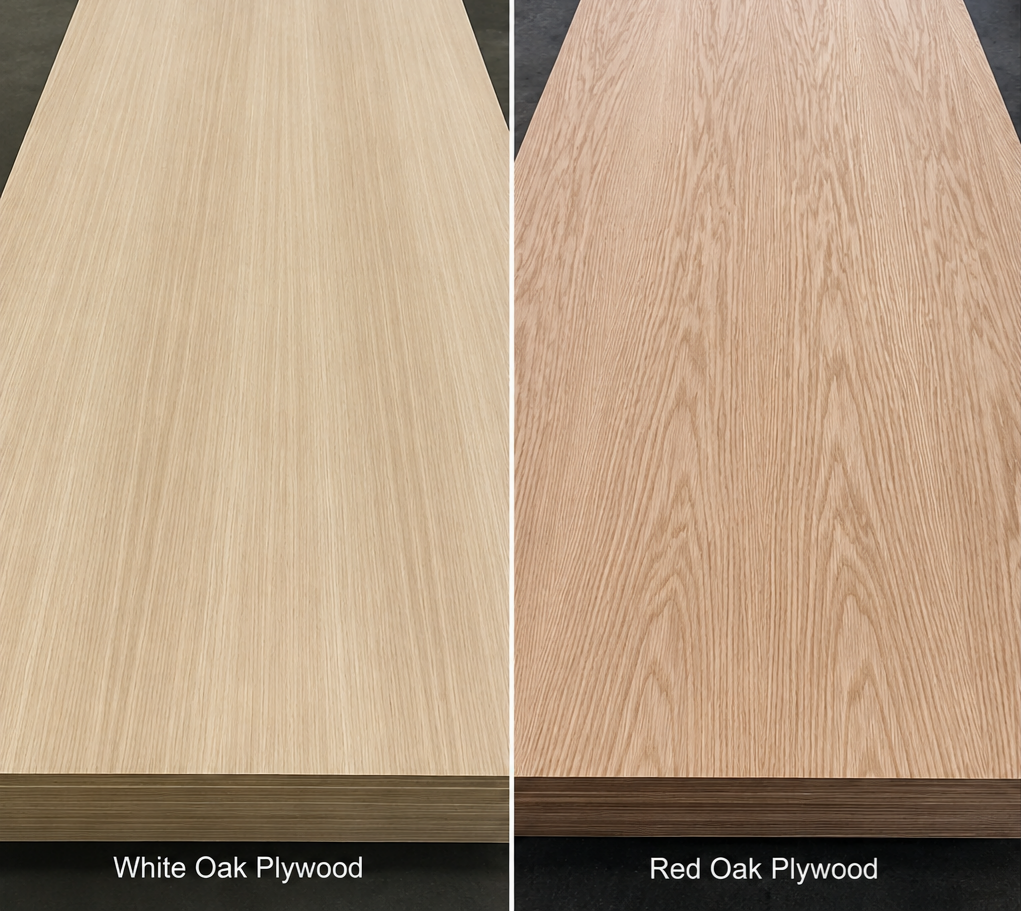
Introduction: Hardwood Plywood Quality Starts Before the Finished Panel
When international B2B buyers and commercial procurement managers purchase hardwood plywood, they often focus on baseline specs:
- Wood Species (Red Oak, White Oak, Maple, Birch)
- Panel Thickness and Tolerances
- Core Material Construction
- Price per Sheet
However, professional furniture manufacturers, cabinet factories, and interior contractors know that one decisive factor dictates the final end-product value and visual appeal: The hardwood plywood face grade.
A premium decorative hardwood plywood panel is not simply made from expensive raw wood species. In accordance with American national standards (ANSI/HPVA HP-1), the final surface quality depends on:
- Veneer flitch selection and grading
- Veneer component width prior to assembly
- Strict sapwood and heartwood color control
- Grain matching symmetry and method
- Joint edge alignment and splice quality
- Acceptable limits of natural wood characteristics
Understanding HPVA face grade standards is essential for precise Purchase Order (PO) specifications and avoiding costly quality disputes.
1. What Does HPVA Hardwood Plywood Grade Actually Mean?
A common misconception is:
“An ‘A Grade’ panel refers to the quality of a single, raw veneer sheet before assembly.”
This is technically incorrect.
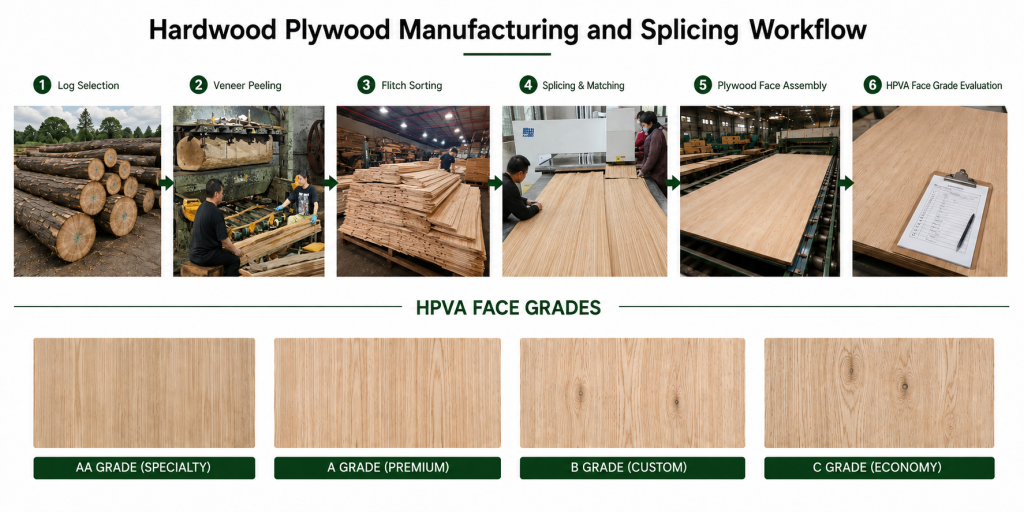
Under the ANSI/HPVA HP-1 standard, hardwood plywood face grades (AA, A, B, C) apply strictly to the completed, spliced, and assembled plywood face sheet on the finished panel.
The manufacturing process follows a rigorous quality progression:
Log Selection → Veneer Slicing/Peeling → Flitch Sorting → Splicing & Matching Assembly → Plywood Face Assembly → HPVA Face Grade Evaluation
The final grading evaluates the visual quality, consistency, and integrity of the completed face, including:
- Color balance across spliced components
- Natural wood feature distribution (mineral streaks, knots, spots)
- Tightness and shade matching at veneer joints
- Grain symmetry and component width consistency
- Absence or restriction of surface defects
2. Understanding HPVA AA, A, B and C Face Grades
HPVA face grades classify the visual appearance and feature limitations of finished hardwood plywood faces. Higher grades demand tighter veneer matching, wider individual components, and minimal natural variations.
HPVA Hardwood Plywood Face Grade Comparison Matrix
| Quality Feature | AA Grade (Specialty) | A Grade (Premium) | B Grade (Custom) | C Grade (Economy) |
| Overall Visual Appearance | Highest architectural standard. Exceptional symmetry and uniform character. | Premium commercial standard. Highly uniform with controlled natural traits. | Natural wood appearance. Moderate grain and character variations allowed. | Utility / Economy standard. Significant natural variations permitted. |
| Surface Uniformity | Excellent consistency across panel width. | Very good visual harmony across splices. | Moderate uniformity between adjacent strips. | Variable; priority on material yield over matching. |
| Natural Characteristics | Extremely limited; virtually defect-free. | Strictly controlled size and frequency. | More acceptable; subtle natural marks. | More visible streaks, spots, and traits permitted. |
| Target Application | Architectural millwork, luxury furniture, high-end hotel interiors. | Fine cabinetry, commercial casework, visible furniture fronts. | Cabinet interiors, semi-exposed panels, stained casework. | Unexposed furniture parts, utility paneling, painted backing. |
3. HPVA Color and Natural Characteristic Control Standards
While natural grain characteristics give hardwood plywood its organic beauty, commercial grade standards dictate how these features are controlled across spliced components.
3.1 Sapwood Control
Sapwood is the lighter-colored outer growth ring of the tree. In heartwood-selected face grades, sapwood contrast must be tightly controlled.
| HPVA Grade | Sapwood Control Specification |
| AA Grade | Not permitted in heartwood-selected faces; total color uniformity required. |
| A Grade | Sapwood is permitted only in rotary-cut veneer unless otherwise specified. |
| B Grade – Red Oak | Allows approximately 10–20% sapwood. |
| B Grade – White Oak | Allows up to 10% sapwood in rift-sawn, comb-grain, quarter-sawn, and plain-sliced veneer, and up to 20% sapwood in rotary-cut veneer. |
| C Grade | Allowed without percentage limits according to standard species rules. |
Sapwood control is particularly crucial for premium White Oak plywood and Red Oak plywood, where stark white-to-brown contrast ruins stain consistency on finished furniture.
3.2 Heartwood Integration
Heartwood represents the darker central core of the tree. For Red and White Oak plywood, heartwood is naturally desirable, provided the tonal variation across spliced components is balanced.
3.3 Color Streaks and Mineral Spots
Mineral absorption during tree growth creates natural color streaks or spots. HPVA standards strictly govern their size and visibility:
- AA / A Grade: Mineral streaks are restricted to isolated, extremely minor lines that blend into the surrounding grain.
- B / C Grade: Medium to prominent mineral streaks are permitted, provided they do not compromise panel structural integrity.
3.4 Color Variation Across Components
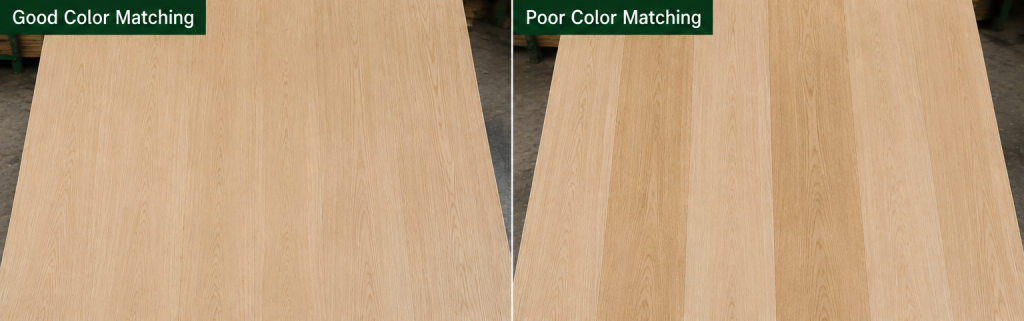
Natural wood inevitably exhibits tone shifts. The difference between HPVA grades lies in component-to-component visual harmony:
| HPVA Grade | Color Variation Requirement |
| AA Grade | Very slight |
| A Grade | Very slight; harmonious shade progression across the panel face. |
| B Grade | Acceptable; natural tonal shifts between adjacent splices allowed. |
| C Grade | More visible contrast permitted across spliced strips. |
3.5 Sharp Color Contrast at Veneer Joints
For Red Oak and White Oak plywood, AA, A, and B Grade faces may contain natural color variation between adjacent veneer components. When using slip matching, strip matching, or random matching, the components do not necessarily need to have identical color or tone. The key requirements are tight joints, proper assembly, and an overall visually acceptable appearance.
4. Veneer Matching Methods in HPVA Hardwood Plywood
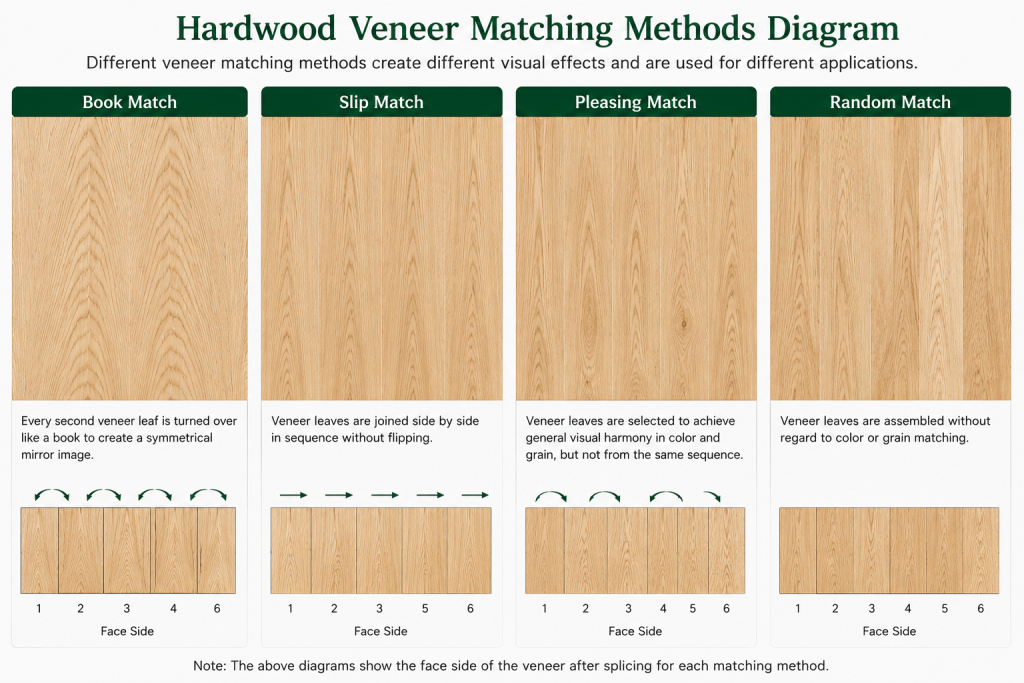
The visual pattern of an assembled face sheet depends directly on how individual veneer flitches are arranged during splicing.
Book Matching
Every second veneer leaf is turned over like a page in a book. Grain patterns meet at the joint line to create a symmetrical mirror image.
- Visual Effect: Creates a symmetrical or mirrored appearance when adjacent veneer leaves are arranged face-to-face.When used with plain-sliced veneer, book matching can create pronounced cathedral patterns.
- Primary Applications: Architectural woodwork, luxury furniture fronts, wall paneling.
Slip Matching
Veneer components are joined side by side in sequence without flipping.
- Visual Effect: Uniform grain direction, minimizing “barber pole” light reflection effects in cut woods.
- Primary Applications: Cabinet doors, commercial casework, long wall runs.
Pleasing Match
Veneer components are selected to achieve general visual harmony in color and grain, though leaves may not originate from the exact same flitch sequence.
- Visual Effect: Balanced, natural wood look with subtle variation.
- Primary Applications: Standard furniture components, retail fixtures.
Random Matching
Veneer components are assembled deliberately without regard to color or grain matching.
- Visual Effect: Casual, rustic appearance maximizing log utilization.
- Primary Applications: Commercial interior backing, painted/stained utility casework.
5. Minimum Width Requirements of Face Veneer Components
A critical technical parameter distinguishing premium HPVA panels from low-grade decorative plywood is the width of individual veneer components prior to face splicing.
Wider components require larger, higher-grade veneer logs and produce a cleaner, more continuous surface with fewer joint lines.
HPVA Minimum Component Width Standards (ANSI/HPVA HP-1)
| Veneer Cutting Method | AA Grade | A Grade | B Grade | C Grade |
| Plain-Sliced (Flat Cut) | 152 mm (6.0 in) | 127 mm (5.0 in) | 76 mm (3.0 in) | No Limit |
| Quarter Cut / Rift Cut | 76 mm (3.0 in) | 76 mm (3.0 in) | 76 mm (3.0 in) | No Limit |
| Rotary Cut | 152 mm (6.0 in) | 127 mm (5.0 in) | 102 mm (4.0 in) | No Limit |
Why Veneer Component Width Matters in B2B Sourcing
A White Oak plywood panel made with 152mm+ wide components shows full, sweeping cathedral grain. Conversely, a panel built from narrow 50mm off-cut strips results in excessive splice lines, visually cluttering the finish.
Demanding AA and A Grade compliance ensures your supplier uses high-diameter hardwood logs and precision splicing machinery.
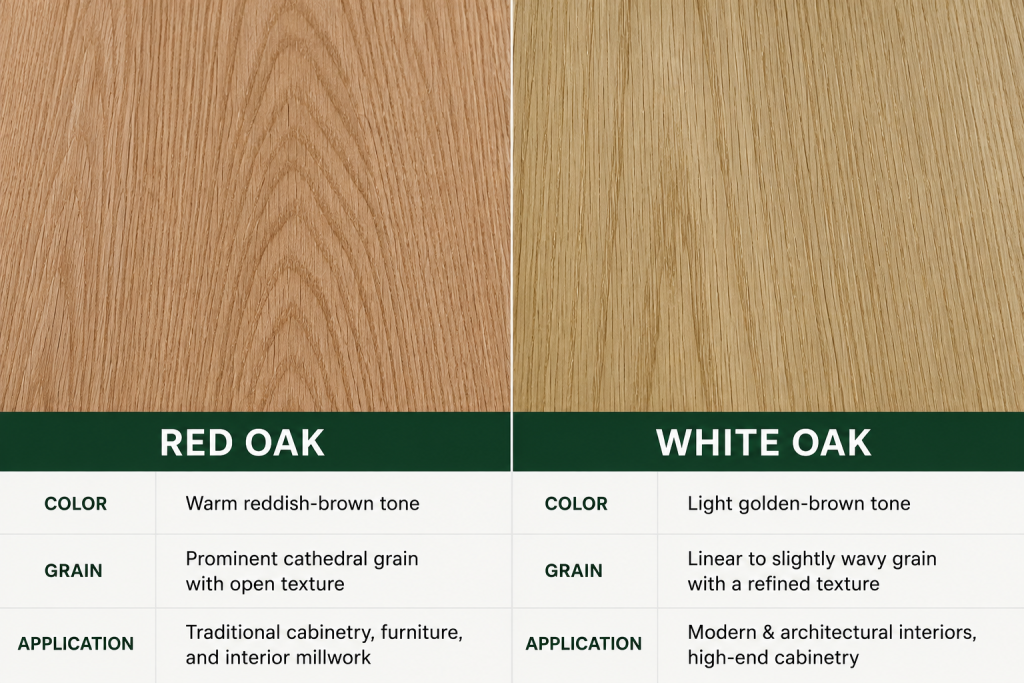
6. Red Oak and White Oak Hardwood Plywood Grade Selection Guide
Red Oak and White Oak dominate North American and European architectural plywood markets.
Red Oak Plywood Characteristics
- Visual Trait: Prominent cathedral grain with warm, reddish-pink undertones.
- Pore Structure: Open pores that absorb stains readily for bold, high-contrast finishes.
- Best HPVA Application: A Grade Plain Sliced for traditional cabinetry, office furniture, and residential casework.
White Oak Plywood Characteristics
- Visual Trait: Golden-wheat to light-brown tones with tighter, linear grain patterns.
- Pore Structure: Tyloses-plugged pores with a distinctive grain structure that complements modern minimalist aesthetics.
- Best HPVA Application: AA or A Grade Quarter/Rift cut for high-end architectural millwork and hotel interiors.
7. Face Grade vs. Core Quality: Two Distinct Specifications
Surface aesthetic grade and structural core performance are two distinct specifications. A flawless A-grade face veneer cannot compensate for a weak or unstable inner core.
| Specification Dimension | Evaluated Standard | Key Performance Indicators |
| Face / Back Grade (HPVA) | Visual Aesthetics & Surface Symmetry | Veneer matching, color control, component width, knot/streak limits. |
| Core Construction | Structural Performance & Machining | Screw holding strength, dimensional stability, core voids, telegraphing resistance. |
8. How to Specify Hardwood Plywood in a Purchase Order
To prevent misunderstandings with overseas manufacturers, include all seven criteria in your Purchase Orders (PO):
- Wood Species: e.g., White Oak (Quercus alba)
- HPVA Face / Back Grade Combination: e.g., Grade A/B or Grade AA/A
- Veneer Slicing Cut: Plain Sliced, Quarter Cut, Rift Cut, or Rotary Cut
- Veneer Splicing Match: Book Match, Slip Match, or Pleasing Match
- Component Width Requirement: Standard HPVA minimums (e.g., ≥152mm for Plain Sliced)
- Core Material & Thickness: e.g., 18mm Combi Core / Full Birch Core
- Bond / Formaldehyde Compliance: CARB Phase 2 / EPA TSCA Title VI / specified E0 requirement, as applicable.
9. Why Partner with Voyage Wood Products for HPVA Grade Plywood
At Voyage Wood Products, we manufacture hardwood plywood for global distributors, cabinet manufacturers, and architectural contractors, with a focus on consistent veneer selection, precise face assembly, stable core construction, and documented quality control.
- Strict Log & Veneer Selection: Precision grading before and after splicing.
- Advanced Splicing Lines: Guaranteed component widths and tight joint matching.
- Stable Core Engineering: Premium Combi Core and Hardwood Core options.
- Complete Quality Documentation: Full inspection reports provided prior to shipping.
- Dual Manufacturing Bases: With manufacturing facilities in China and Nigeria, supported by the necessary licenses, certifications, and export documentation, we have the infrastructure and logistics capability to serve customers and ship plywood to global markets.
Conclusion
Understanding hardwood plywood face grades requires evaluating complete face assembly, component width, sapwood restriction, and visual harmony—far beyond simple single-veneer inspection.
By specifying clear HPVA face grades alongside structural core requirements, professional buyers can secure consistent, high-value Red Oak and White Oak plywood shipments for their projects.
Ready to Upgrade Your Plywood Procurement?
Request Hardwood Plywood Samples & Specification Sheets Today
Contact Voyage Wood Products technical sales team to receive:
- Physical Red Oak and White Oak HPVA Grade Samples (AA / A / B)
- Downloadable HPVA Grade Comparison Technical Matrix (PDF)
- Custom Factory Direct Quotes & OEM Sourcing Support
Frequently Asked Questions (FAQ)
What does A grade mean in hardwood plywood?
Under ANSI/HPVA HP-1 standards, A grade refers to the premium appearance quality of the completed, spliced face sheet on a finished panel, requiring controlled natural characteristics and strict veneer matching—not an individual raw veneer leaf.
What is the primary difference between AA grade and A grade plywood?
AA grade is the highest standard face grade requiring maximum color uniformity, zero sapwood in heartwood faces, and seamless matching.
A grade is a premium commercial standard allowing slightly more natural wood character while maintaining strict component width and matching consistency.
Does HPVA face grade affect plywood structural strength?
No. HPVA face grades evaluate surface appearance, color control, and veneer matching. Panel strength, screw-holding ability, and flatness are determined by core construction (e.g., Combi Core, Eucalyptus Core, MDF Core) and resin quality.