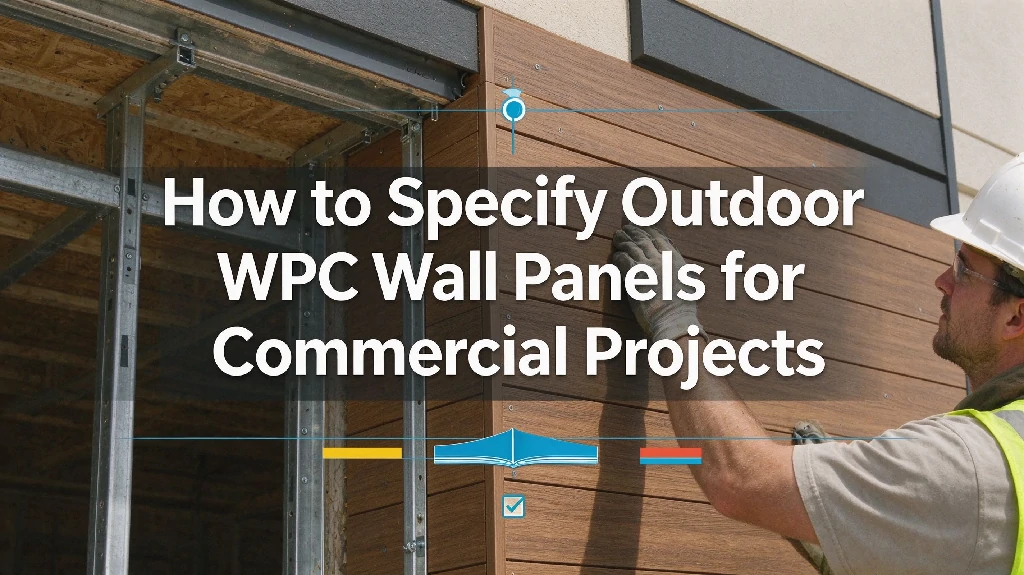
How to Specify Outdoor WPC Wall Panels for Commercial Projects
November 24, 2026
Outdoor WPC wall panels are used in commercial buildings, residential developments, hospitality projects, and exterior renovation applications. However, selecting a suitable product involves more than choosing a color or surface texture.
A reliable outdoor WPC wall panel specification should define the panel structure, material composition, dimensions, installation system, weather exposure, surface performance, and project maintenance requirements.
WPC, or wood-plastic composite, combines wood-based materials with thermoplastic polymers and other additives. The resulting composite is designed to provide a decorative panel solution with characteristics different from conventional solid wood cladding.
For architects, contractors, distributors, and building material buyers, understanding these specifications helps reduce installation risks and improve product selection.
1. What Are Outdoor WPC Wall Panels?
Outdoor WPC wall panels are composite cladding products manufactured using wood-based materials, plastic polymers, and formulation additives. Depending on the product design, panels may feature solid or hollow profiles, different surface textures, and different extrusion structures.
Some products use co-extrusion technology, which adds an outer protective layer around the composite substrate. The exact construction varies by manufacturer and product series.
Outdoor WPC wall panels are commonly considered for:
- Exterior residential wall cladding
- Commercial building facades
- Hotel and resort exterior decoration
- Balcony and terrace wall finishes
- Garden buildings and landscape structures
- Decorative exterior renovation projects
The suitability of a panel depends on its verified technical performance and the conditions at the installation site. A product intended for sheltered decorative use should not automatically be specified for an exposed facade with severe weather conditions.
2. Solid vs Hollow WPC Wall Panels
One of the first decisions in WPC wall panel selection is the profile structure.
Solid and hollow panels differ in material consumption, weight, internal geometry, and installation considerations. Neither structure is universally better.
| Comparison factor | Solid WPC wall panels | Hollow WPC wall panels |
|---|---|---|
| Internal structure | Solid composite profile | Contains internal cavities |
| Material consumption | Generally higher for comparable external dimensions | Generally lower for comparable external dimensions |
| Weight | Usually heavier | Usually lighter |
| Handling | May require more handling effort | Often easier to handle |
| Profile design | Depends on extrusion design | Depends on cavity layout and wall thickness |
| Installation | Requires compatible fixing system | Requires compatible fixing system and attention to profile support |
| Selection priority | Section strength and intended fixing method | Wall thickness, cavity design, and fixing compatibility |
When comparing profiles, buyers should not rely on the words “solid” or “hollow” alone. They should request cross-sectional drawings, actual dimensions, wall thickness, unit weight, and installation instructions.
For projects exposed to wind loads or frequent temperature changes, the complete cladding system must be evaluated. Panel structure, fixing spacing, subframe design, and building substrate all contribute to the final performance.
3. Co-Extruded WPC Wall Panels: What Should Buyers Check?
Co-extruded WPC panels generally feature an additional outer layer formed around the core during the manufacturing process. This surface layer is designed to provide specific decorative and protective characteristics.
The actual performance depends on the material formulation, layer thickness, bonding quality, surface treatment, and manufacturing control.
When specifying co-extruded outdoor WPC wall panels, buyers should confirm the following:
Outer layer composition
Ask the supplier to identify the material used in the outer layer and explain how it differs from the core composition.
Layer thickness and consistency
Confirm whether the protective layer has a defined thickness specification and whether quality checks cover consistency across the panel.
Surface durability
Request relevant test information for scratch resistance, staining, and other surface properties that matter to the project.
Color and texture consistency
For large projects, color variation between production batches can affect the appearance of the finished facade. Buyers should confirm sample approval and batch-control procedures.
Layer bonding
The outer layer should remain properly bonded to the substrate under the product’s intended service conditions. Buyers should request relevant quality information rather than assuming all co-extruded products perform identically.
Co-extrusion is a product construction method, not a guarantee of a particular service life. Buyers should evaluate the complete product specification and supporting test documentation.
4. Weather Exposure and Dimensional Stability
Outdoor wall panels experience changing temperatures, sunlight, humidity, and rain. These conditions can affect the dimensions and appearance of composite materials.
WPC panels may expand and contract as temperatures change. Installation design must therefore allow for the movement specified by the manufacturer.
Key considerations include:
Thermal Expansion
Panel length, installation temperature, fixing method, and expansion gaps should be considered together. Insufficient allowance for movement may contribute to buckling, deformation, or stress around fixing points.
Moisture Exposure
WPC materials are designed differently from untreated natural wood, but this does not mean every product is completely waterproof or suitable for permanent water exposure.
Buyers should confirm the product’s water absorption data, intended exposure conditions, drainage requirements, and maintenance instructions.
UV Exposure
Outdoor sunlight can affect color and surface appearance over time. Ask for available UV-resistance or weathering test information and clarify the test method and evaluation criteria.
Temperature Fluctuations
Products installed in regions with significant seasonal temperature differences require particular attention to expansion allowances, subframe compatibility, and fixing details.
Project specification tip: Ask suppliers for installation temperature guidance, recommended expansion gaps, maximum installation lengths, and fixing spacing. These details should be included in the project installation documentation.
5. WPC Wall Panel Dimensions, Profiles, and Installation Systems
The dimensions and profile design of WPC wall panels influence appearance, material planning, and installation efficiency.
Before ordering, buyers should confirm:
| Specification | What to confirm | Why it matters |
|---|---|---|
| Panel width | Overall and effective coverage width | Determines layout and quantity |
| Panel thickness | Actual profile thickness | Affects section design and fixing compatibility |
| Panel length | Standard and customized lengths | Influences joint locations and material waste |
| Profile shape | Cross-section and connection design | Determines panel alignment and installation |
| Unit weight | Weight per panel or per square meter | Supports handling and subframe planning |
| Surface finish | Wood grain, brushed, or other textures | Affects architectural appearance |
| Color | Standard and customized color options | Supports project coordination |
| Accessories | Clips, trims, corner profiles, and connectors | Helps ensure a complete installation system |
A complete WPC wall cladding system may include more than the visible panels. Subframes, clips, screws, corner trims, starting profiles, and finishing accessories should be checked for compatibility.
For large-scale projects, request a complete installation drawing before procurement. It should identify the panel direction, support spacing, fixing method, corner treatment, joint design, and openings around windows and doors.
6. How to Estimate WPC Wall Panel Quantities
Accurate quantity planning helps reduce shortages, unnecessary inventory, and installation waste.
A basic estimate starts with the total wall area:
Net wall area = Total wall area − Openings
Openings include windows, doors, and other areas that will not receive cladding.
The approximate panel quantity can then be calculated using the effective coverage area of each panel:
Panel quantity = Net wall area ÷ Effective coverage area per panel
The effective coverage width is not always the same as the overall panel width. Overlapping joints or interlocking connections may reduce the actual covered area.
A practical procurement calculation should also consider:
- Cutting and installation waste
- Corner and edge details
- Panel direction and layout
- Openings and irregular wall shapes
- Customized panel lengths
- Spare panels for future maintenance
For complex facades, the final quantity should be calculated from approved elevation drawings and the manufacturer’s actual coverage dimensions.
7. WPC Wall Panels vs Traditional Exterior Wall Finishes
WPC wall panels are one of several options for exterior decorative cladding. Their suitability should be compared with the project’s design, maintenance expectations, installation conditions, and performance requirements.
| Evaluation factor | WPC wall panels | Natural timber cladding | Conventional masonry or rendered finishes |
|---|---|---|---|
| Material composition | Wood-plastic composite | Natural wood | Mineral-based materials |
| Appearance | Available in different colors and wood-grain textures | Natural wood grain | Depends on coating and finish |
| Maintenance | Depends on product formulation and exposure | May require periodic treatment | Depends on coating and surface condition |
| Installation | Uses a panel and fixing system | Uses timber cladding details | Uses masonry or rendering processes |
| Dimensional behavior | Thermal movement should be considered | Moisture-related movement should be considered | Cracking and substrate movement should be considered |
| Design flexibility | Profile, color, and length options vary | Species and board profiles vary | Texture and coating options vary |
This comparison is general. Actual maintenance intervals, service performance, and installation costs depend on the selected product, local climate, substrate, and workmanship.
WPC should not be specified as a universal replacement for every exterior wall material. Fire performance, structural requirements, building regulations, and facade-system approvals must be reviewed for the intended application.
8. What Documents Should Buyers Request from a WPC Wall Panel Supplier?
For commercial projects, technical documentation is an important part of supplier evaluation.
Buyers should request relevant information for the specific product model rather than relying on general company brochures.
A practical document checklist includes:
- Technical data sheet: Product composition, dimensions, profile structure, and available specifications.
- Cross-sectional drawing: Internal profile geometry and wall thickness.
- Installation guide: Fixing method, support spacing, expansion allowance, and accessory requirements.
- Weathering information: Available UV, color stability, and weather-resistance test results.
- Physical performance data: Relevant dimensional, mechanical, and water-related test information.
- Fire-performance documentation: Applicable test reports and classifications for the target market and intended application.
- Quality-control information: Inspection procedures, production tolerances, and batch consistency.
- Sample and color confirmation: Approved samples for appearance and project coordination.
Not every project requires the same documents. Buyers should identify local building regulations and project-specific approval requirements before confirming the order.
9. Common Mistakes When Purchasing Outdoor WPC Wall Panels
Several procurement mistakes can create problems during installation or after project completion.
Choosing based on appearance alone
A wood-grain finish may look suitable in a sample, but the product still needs to meet the project’s weather exposure, fixing, and performance requirements.
Ignoring thermal expansion
Outdoor panels can move as temperatures change. Installation gaps and fixing details should follow the manufacturer’s technical instructions.
Comparing products by thickness only
Two panels with the same external thickness may have different internal structures, material formulations, and unit weights.
Ordering panels without compatible accessories
Missing trims, clips, corner profiles, or fixing components can delay installation and affect the finished appearance.
Accepting unsupported performance claims
Statements such as waterproof, fireproof, maintenance-free, or lifetime color stability should be supported by product-specific evidence and applicable test documentation.
Skipping sample approval
For large projects, buyers should approve samples and confirm color, texture, dimensions, and installation details before mass production.
10. Frequently Asked Questions
Are outdoor WPC wall panels suitable for commercial buildings?
They can be considered for commercial exterior decoration and cladding projects when the product specification, installation system, fire performance, and local building requirements are suitable for the intended application.
What is the difference between co-extruded and standard WPC wall panels?
Co-extruded WPC panels have an additional outer layer formed around the composite core. Standard WPC panels may have a more uniform material structure throughout the profile. Buyers should compare the actual surface composition, layer thickness, bonding quality, and test data.
Do WPC wall panels expand in hot weather?
Yes. WPC panels can experience thermal expansion and contraction. The installation system should provide the expansion allowance specified by the manufacturer.
Are hollow WPC wall panels suitable for outdoor use?
Hollow WPC profiles can be used in outdoor applications when their design and technical performance meet the project requirements. Buyers should check wall thickness, cavity design, fixing compatibility, and relevant performance documentation.
How do I calculate the quantity of WPC wall panels?
Calculate the net wall area after deducting openings, then divide it by the effective coverage area of each panel. Add an appropriate allowance for cutting, layout, and installation waste.
What should I check before importing WPC wall panels?
Confirm product specifications, profile drawings, samples, installation accessories, packaging, order quantity, shipping arrangements, and documentation required by the destination market.
11. Final Specification Checklist
Before placing a purchase order, confirm that the following information has been agreed:
- Product series and profile structure
- Solid or hollow construction
- Standard or co-extruded surface
- Panel dimensions and tolerances
- Unit weight and effective coverage
- Color, texture, and sample approval
- Installation accessories and fixing method
- Expansion gaps and support spacing
- Relevant performance test documentation
- Packaging, quantity, and shipping requirements
A well-defined specification helps architects, contractors, and distributors compare products more accurately and reduce uncertainty during procurement.
Explore Outdoor WPC Wall Panel Solutions from Voyage
Voyage supplies building material solutions for international buyers, including WPC wall panel products for indoor and outdoor applications. Product selection can be discussed according to profile design, dimensions, surface appearance, and project requirements.
Explore our WPC Wall Panel range or contact Voyage to discuss product specifications, samples, and project sourcing requirements.