Hardwood Plywood Core Types Explained
October 26, 2026
Veneer core vs MDF core vs particleboard core
Introduction
Understanding hardwood plywood core types helps buyers compare panels beyond face species, veneer grade, grain and price. Two panels with the same hardwood face can behave differently in production and service.
The core influences flatness, dimensional stability, screw holding, bending stiffness and strength, cut-edge quality, weight and cost. Selecting it early helps buyers match the panel to the finished component.
Three common hardwood plywood core types are veneer core, medium-density fiberboard (MDF) core and particleboard core. Veneer core is often a starting point for fastening and strength relative to weight. MDF core suits flat decorative components that need a uniform substrate. Particleboard core can suit standardized interior furniture where material cost matters.
The best choice meets the component’s performance requirements at an acceptable finished-product cost. A lower sheet price can lose its advantage through extra edging, assembly work or rejects.
This guide explains how the three core types differ, where each performs well, and what B2B buyers should confirm before placing an order.
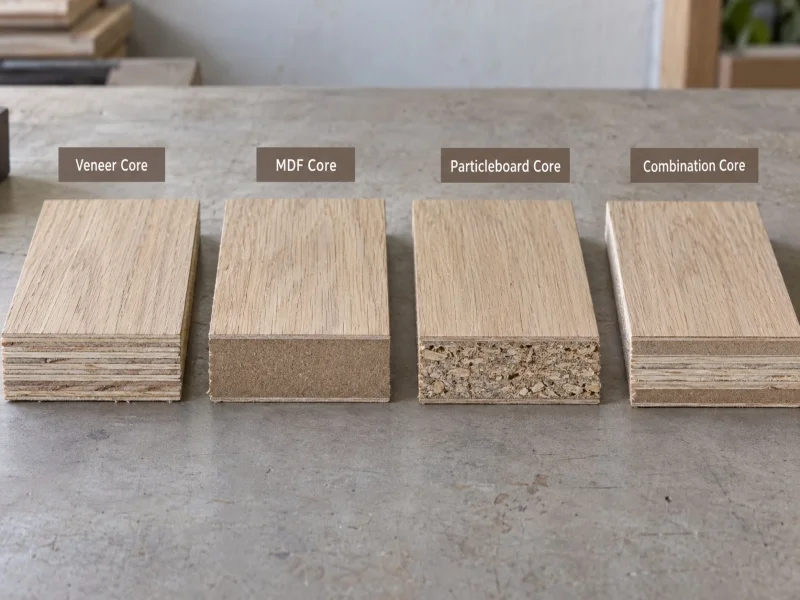
1 What Is a Core in Hardwood Plywood
Hardwood plywood typically consists of a decorative hardwood face veneer, a back veneer, and an internal core structure. The face veneer provides the visible wood appearance, while the core contributes much of the panel’s physical performance.
In decorative hardwood plywood, the hardwood face does not establish the species or material used throughout the core.
The core may use cross-laminated wood veneers, MDF, particleboard or a combination of materials. Lumber core is another option. A different core can be used under the same face veneer, provided its weight, stiffness, hardware and moisture performance meet the component specification.
When evaluating a panel, buyers should distinguish between three separate questions:
- Appearance: Does the hardwood face meet the required species, grade, grain, and matching standards?
- Panel performance: Does the core provide the required flatness, stability, strength, and fastening performance?
- Manufacturing suitability: Can the finished panel be cut, drilled, edge-banded and assembled using the planned equipment and hardware, while preserving its decorative face?
Specify the face and core separately. Voyage’s guide to hardwood plywood face grades explains the appearance requirements to confirm alongside core performance.
2 Veneer Core for Strength and Fastening
Veneer core plywood is constructed from multiple wood veneer layers bonded together, generally with adjacent layers oriented in alternating grain directions. This cross-laminated structure helps balance movement and provides useful strength across the panel.
Main advantages
Strong screw-holding performance
Veneer core is often preferred when mechanical fastening is important. It can be suitable for cabinet components, furniture structures, and assemblies where screws or other fasteners carry meaningful loads.
Holding strength depends on veneer quality, panel thickness, fastener type, edge distance and joint design. Approve the proposed hardware on representative samples when the connection carries significant loads.
Good strength-to-weight characteristics
Veneer core panels can provide a useful balance between stiffness, strength, and weight. This can matter when furniture components must be handled, transported, or installed on site.
Useful dimensional stability
Cross-lamination helps control directional movement during normal indoor humidity changes. Bending performance can still differ with panel direction, so orientation matters for shelves and long components.
Stability still depends on panel construction, veneer quality, moisture conditions, and balanced face-and-back construction.
Limitations to consider
- Surface irregularities: Gaps or uneven internal layers can show through a thin face veneer, especially under a high-gloss finish.
- Thickness variation: Some products may have greater thickness variation than well-calibrated MDF or particleboard core panels.
- Internal voids: Gaps or defects in the core can affect machining, fastening, and edge finishing if quality control is inadequate.
- Finish preparation: Depending on the face veneer and finish system, additional sanding, filling, or substrate preparation may be required.
A clear specification for core gaps, thickness tolerance and surface appearance helps buyers select a suitable veneer-core product.
Suitable applications
Veneer core is worth evaluating for:
- Cabinet sides and structural furniture components
- Furniture frames and components requiring reliable mechanical fastening
- Shelves where span, load, and panel thickness are properly specified
- Components that will be installed or assembled with screws
- Applications where a balance of strength, weight, and dimensional stability is important
Procurement takeaway: Start with veneer core when fastening, stiffness and handling weight are priorities. Confirm its layup, thickness and core quality against the intended load and hardware.
3 MDF Core for Smooth Surfaces and Consistent Thickness
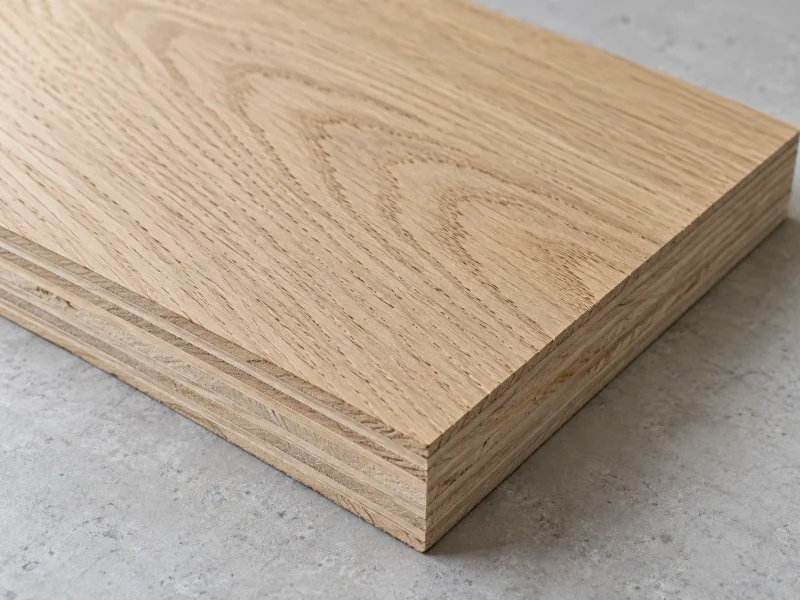
Medium-density fiberboard core plywood uses MDF as its central substrate, covered with decorative hardwood veneer. MDF is manufactured from wood fibers bonded under heat and pressure, producing a relatively uniform material without the alternating veneer layers found in veneer core.
Main advantages
A uniform substrate for decorative finishes
MDF core provides a smooth, uniform base beneath decorative wood veneer. This makes it useful for flat cabinet doors, furniture panels and interior panels where an even surface is important.
A uniform core can help reduce the risk of internal veneer patterns becoming visible through the face. The final result still depends on face veneer thickness, adhesive, pressing, sanding, and finishing processes.
Predictable cutting and drilling
The uniform substrate can support consistent sizing, drilling and preparation for edge banding. Use sharp tools and suitable settings to keep the decorative veneer clean at cut edges.
Bare MDF is also used for routed or profiled components, but that is a separate manufacturing route. Deep routing through a veneered panel removes the wood face and exposes the core, so profiled designs need a planned machining and finishing sequence.
Good flatness and thickness consistency
MDF core can provide good flatness and consistent thickness, helping components fit hardware and receive an even decorative finish.
Confirm the finished panel’s thickness tolerance and balanced face-and-back construction on the approval sample.
Limitations to consider
Weight
MDF core panels can be heavy. This may increase handling effort, transportation weight, and installation difficulty, particularly for large cabinet doors or wall panels.
Fastening requirements
MDF core does not necessarily provide the same screw-holding performance as veneer core, particularly at edges. The appropriate fastener, pilot hole, edge distance, and reinforcement method should be established for the actual application.
For large doors, check hinge loading against the complete door weight and dimensions. Properly specified MDF doors can perform well when the hardware and fixing details suit the panel.
Moisture sensitivity
Standard MDF core should not be assumed suitable for prolonged moisture exposure. Moisture-resistant variants are available, but their performance depends on the specific product and test requirements. A moisture-resistant designation does not automatically mean waterproof.
Tooling and processing
MDF’s density and fiber structure affect tool wear and dust extraction. Review cutting speeds, tooling and edge preparation for the intended panel and finish.
Suitable applications
MDF core is worth evaluating for:
- Flat wood-veneered decorative panels with the specified clear or opaque finish
- Flat veneered cabinet door fronts with suitable hinges
- Furniture components requiring consistent surface quality
- Decorative panels where flatness and thickness consistency are important
- Veneered furniture components with matching edge banding
Procurement takeaway: Evaluate MDF core when surface uniformity and consistent dimensions are priorities. Match the hardware to the panel weight and fastening requirements, and specify any moisture-resistance requirement separately.
4 Particleboard Core for Flatness and Cost Control
Particleboard core plywood uses an industrial particleboard substrate beneath decorative hardwood face and back veneers. The particleboard is made from wood particles bonded together under pressure with a suitable resin system.
Main advantages
Good surface uniformity and flatness
Industrial particleboard core can provide a consistent substrate for decorative veneers and laminates. Its uniform surface can be useful for furniture components produced in standardized sizes.
Cost-conscious material selection
Particleboard core can be an economical choice for suitable interior applications. For high-volume production, the initial panel cost can be an important part of the overall manufacturing calculation.
Compare like-for-like thicknesses, grades and finishes because the price advantage varies with the specification, order volume and market.
Suitable for standardized production
Where components use straightforward cutting, drilling, edging, and assembly processes, particleboard core may provide the consistency needed for repeatable production.
Limitations to consider
Lower screw-holding performance in some applications
Particleboard core generally requires more careful consideration of fastening than veneer core. Edge connections, repeated assembly, and heavily loaded joints can be particular concerns.
Manufacturers should select suitable hardware and test the complete connection design, especially for furniture that will be disassembled or adjusted repeatedly.
Cut edge quality and machining limits
Inspect the cut edges for chipping, particle breakout and banding adhesion. Fine profiles can expose the particle structure, while deep routing through a veneered face also removes the decorative surface.
Moisture-related damage
Standard particleboard can swell when exposed to moisture, and swelling may be difficult to reverse. Moisture-resistant products may be available, but buyers should confirm the precise grade and performance requirements.
Structural requirements must be checked
A flat panel is not automatically suitable for every load-bearing application. Shelf span, thickness, support spacing, load, and fastening method must all be considered.
Suitable applications
Particleboard core is worth evaluating for:
- Cost-conscious decorative furniture panels
- Standardized interior cabinetry in dry environments
- Wardrobe and storage components with suitable support and fastening
- Flat veneered panels for cutting, drilling and edge banding
- Large-volume production where flatness, consistency, and price are key considerations
Procurement takeaway: Particleboard core can be a cost-effective option for compatible interior designs. Include hardware, edging, assembly and expected service conditions in the cost comparison.
5 Hardwood Plywood Core Types Compared
Use this plywood core comparison to narrow the sample request. These are typical tendencies; actual results depend on construction, thickness, quality and the specified test.
Compare the proposed panels at the required thickness and load. The core name alone does not establish a measured performance ranking.
| Performance factor | Veneer Core | MDF Core | Particleboard Core |
| Screw-holding performance | Often strong where fastening is critical | Fastener design matters, especially at edges | Careful fastener and edge-joint design needed |
| Surface uniformity | Can vary with internal veneer construction | Generally very uniform | Generally very uniform |
| Flatness | Depends on construction and calibration | Generally very good | Generally very good |
| Thickness consistency | Depends on manufacturing and calibration | Often very good | Often very good |
| Strength and bending | Often useful strength relative to weight | Depends on panel specification and design | Depends on panel specification and design |
| Cutting and edge finishing | Check core gaps and veneer quality | Consistent substrate for sizing, drilling and banding | Check particle breakout and banding adhesion |
| Weight | Can be relatively light, depending on construction | Can be heavy | Varies with density; may be similar to MDF |
| Moisture considerations | Wood movement and glue-line quality matter | Standard products are moisture-sensitive | Standard products are moisture-sensitive |
| Typical purchasing priority | Strength, fastening, versatility | Surface consistency and thickness control | Flatness, standardized production, cost control |
6 Core Selection for Different Furniture Components
The best core can change within the same furniture product. A cabinet door, cabinet side, and long shelf do not necessarily have the same technical requirements.
Kitchen and wardrobe cabinet carcasses
For cabinet sides and structural components, evaluate fastening performance, dimensional stability, panel thickness, and the intended hardware.
Veneer core is worth considering when screw connections and structural performance are priorities. MDF or particleboard core may also be appropriate for designs that emphasize flatness and standardized production, provided the connection and load requirements are satisfied.
For kitchens, also consider the distance from water sources, edge sealing, and the expected moisture conditions. No standard core should be treated as waterproof without product-specific evidence.
Cabinet doors and decorative fronts
For flat veneered doors, MDF core is a useful starting point when surface consistency matters. If the design includes routed profiles, specify the bare substrate and the machining, veneering or finishing sequence separately.
Veneer core may be appropriate for flat veneered doors or where fastening and weight are more important. Particleboard core may be suitable for simpler, flat door constructions when the design and edging system are compatible.
For large doors, approve the complete construction, including weight, hinge loading, flatness, balanced faces and fixing details.
Shelves and storage components
For shelves, the important variables are span, thickness, load, support spacing, and acceptable deflection.
Veneer core may be attractive where structural performance and fastening matter. MDF and particleboard core can work in properly designed systems, but buyers should validate the required load and span rather than assuming that all 18 mm panels behave alike.
For heavy or long-span shelves, request supporting data or test the intended construction. Include loading duration and acceptable long-term deflection in the assessment.
Commercial displays and decorative wall panels
Commercial displays and wall panels often prioritize surface appearance, flatness, cut-edge quality and installation.
MDF or particleboard core may be appropriate for flat decorative panels. Veneer core may be preferred when lower weight or fastening performance is more important.
For large panels, specify the installation method, support spacing, finish, and environmental conditions. Panel movement, visible surface irregularities, and fixing details should be considered before mass production.
High-volume furniture manufacturing
For production lines, core selection should reflect the whole manufacturing process. Consider cutting yield, tooling, drilling, edge banding, assembly time, defect rates, and finishing requirements.
A lower-priced core may not produce the lowest finished-product cost if it creates additional rework. Conversely, a higher-performance core may be unnecessary if the component has modest requirements and the lower-cost option consistently meets the specification.
7 How Core Selection Affects Total Cost
Total cost is influenced by:
- Panel purchase price and order quantity
- Material yield and cutting layout
- Machining time and tool wear
- Sanding, filling, and finishing requirements
- Edge-banding and fastening methods
- Handling, transportation, and installation
- Scrap, rework, and replacement risk
For example, MDF core may simplify production of flat veneered doors that need consistent thickness and surface quality. Particleboard core may suit standardized parts with compatible hardware. Veneer core may justify its price where fastening, stiffness or lower handling weight matters.
Compare representative samples using the planned cutting, drilling, edge banding and assembly process. Record the cost of producing an acceptable finished part.
8 What B2B Buyers Should Confirm Before Ordering
A clear request helps Voyage recommend suitable constructions and prepare comparable prices. Use our decorative hardwood plywood buying guide alongside the checklist below.
Core and panel specification
- Core type: veneer core, MDF core, particleboard core, or a specified combination
- Face species, cut, matching and face grade
- Panel dimensions, nominal thickness and target finished thickness
- Required thickness tolerance and flatness
- Face and back veneer thickness, back grade and balance requirements
- Bond requirements, emissions compliance and applicable certification documents
Application and manufacturing details
- Intended use: cabinet sides, doors, shelves, furniture parts, or decorative panels
- Required load, shelf span, or fastening performance where relevant
- Cutting, drilling, edge banding and hardware requirements, plus any separately agreed machining sequence
- Decorative face and final finish, including unfinished or factory-prefinished supply
- Expected indoor humidity and potential moisture exposure
- Quantity, destination market, packaging and shipping requirements
Samples and quality approval
Before confirming a large order, evaluate samples for surface appearance, flatness, thickness consistency, edge quality, machining behavior, and compatibility with the intended finish.
Where structural or fastening performance is critical, visual inspection alone is insufficient. Agree on appropriate test methods, acceptance criteria, and supporting technical documents before production.
Approve the reference sample and acceptance criteria together so the visible face, internal construction and finished-part performance match the order.
9 Final Recommendations
- Choose veneer core as a starting point when structural versatility, screw holding, and fastening performance are important.
- Evaluate MDF core for flat decorative components where surface uniformity, flatness and consistent thickness are priorities.
- Evaluate particleboard core when a flat, standardized substrate and cost control are important, and the design is compatible with its fastening and moisture limitations.
Confirm the construction, thickness, hardware and service conditions before approving the core. A change of core is possible when the replacement meets those requirements.
For importers, distributors, cabinet manufacturers, and project buyers, the most effective purchasing approach is to define the application first, compare suitable core constructions second, and evaluate price only after the required performance has been established.
Nigeria Production for US Hardwood Plywood Orders
Voyage combines hardwood plywood supply from China with our own Nigeria factory, giving importers, distributors and cabinet manufacturers another production source for US orders. Discuss your preferred face veneer, core construction and finish with one Voyage contact, and request a supply proposal matched to your specification and purchasing schedule.
We supply panels meeting EPA TSCA Title VI and CARB Phase 2 formaldehyde emission requirements, with the applicable compliance documents and labeling for the quoted product and factory. For Nigeria production, we can also provide shipment and origin information to support the importer’s US entry process. Ask us to include a Nigeria option when planning your next order.
Request Hardwood Plywood Samples and a Quotation
Explore Voyage’s hardwood plywood options, including white oak plywood and maple plywood. Share your face species and grade, core preference, thickness, panel size, quantity and destination market. Include component drawings, hardware or shelf-load requirements where relevant so we can prepare suitable sample options and a comparable quotation.
Contact Voyage to discuss samples, construction details and bulk supply. For US orders, tell us if you would like a Nigeria production proposal and include your destination port and required documents.