EU E05 Formaldehyde Regulation 2026: What Laminate Flooring Buyers Need to Know
May 15, 2026
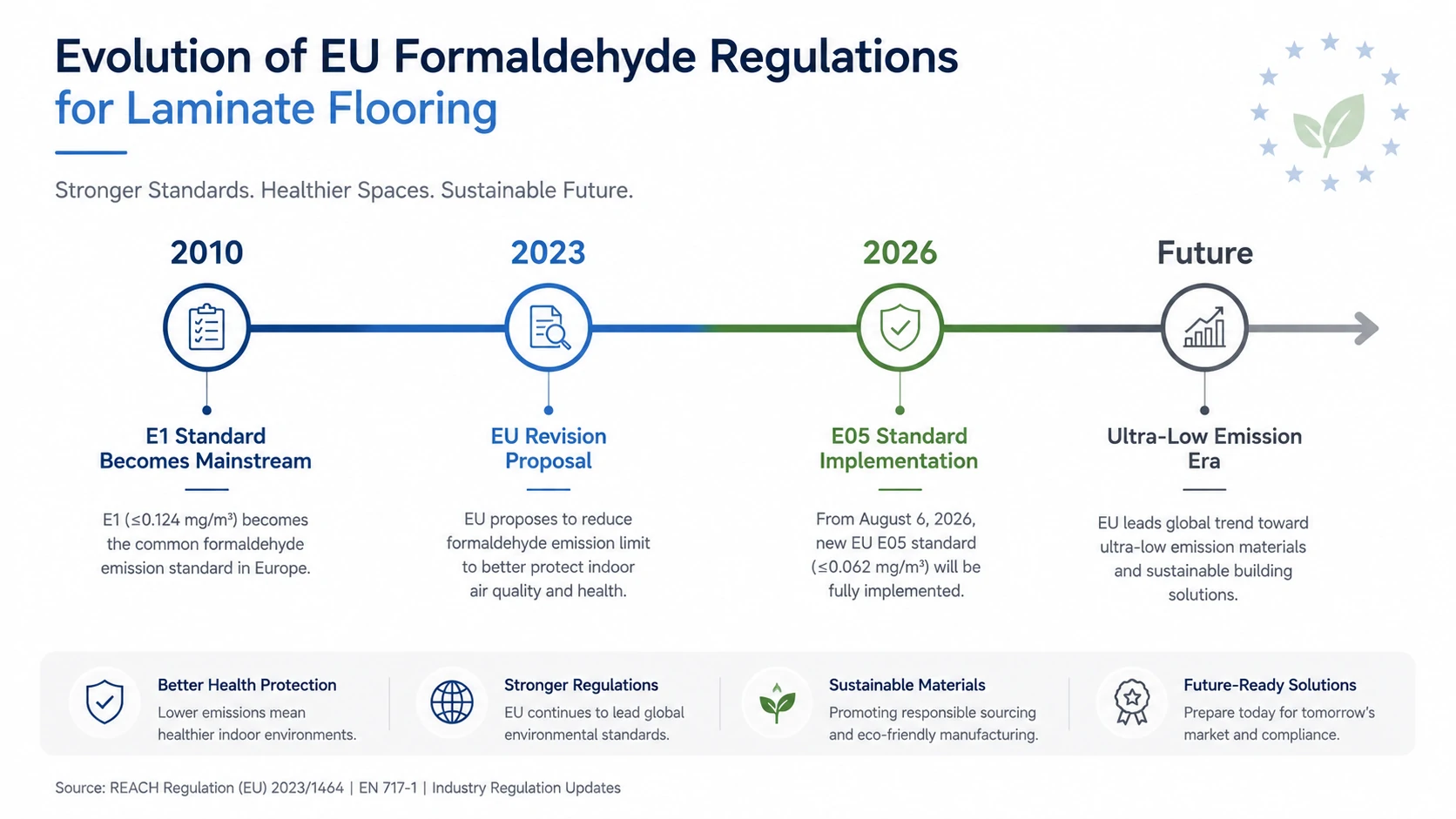
Starting from August 6, 2026, the European Union will reduce the allowable formaldehyde emission limit for wood-based products from:
- 0.124 mg/m³
to: - 0.062 mg/m³
under the revised REACH regulation.
This new requirement is widely known in the flooring industry as:
EU E05 Standard

The regulation will directly affect:
- Laminate flooring
- HDF and MDF boards
- Plywood
- Furniture
- Interior wood-based materials
For laminate flooring manufacturers, importers, and distributors, E05 represents a major shift toward ultra-low emission building materials.
As European environmental standards continue rising, buyers are increasingly evaluating flooring products based not only on appearance and durability, but also on:
- Formaldehyde emissions
- VOC performance
- Environmental compliance
- Long-term sustainability
What Is the EU E05 Standard?
Under the updated EU regulation, wood-based interior products sold in Europe after 2026 must meet a formaldehyde emission limit of:
0.062 mg/m³
This is approximately half of the current E1 standard commonly used across Europe today.
The new regulation aims to improve:
- Indoor air quality
- Consumer health protection
- Environmental transparency
For the laminate flooring industry, this means environmental compliance is rapidly becoming a market requirement rather than a premium feature.
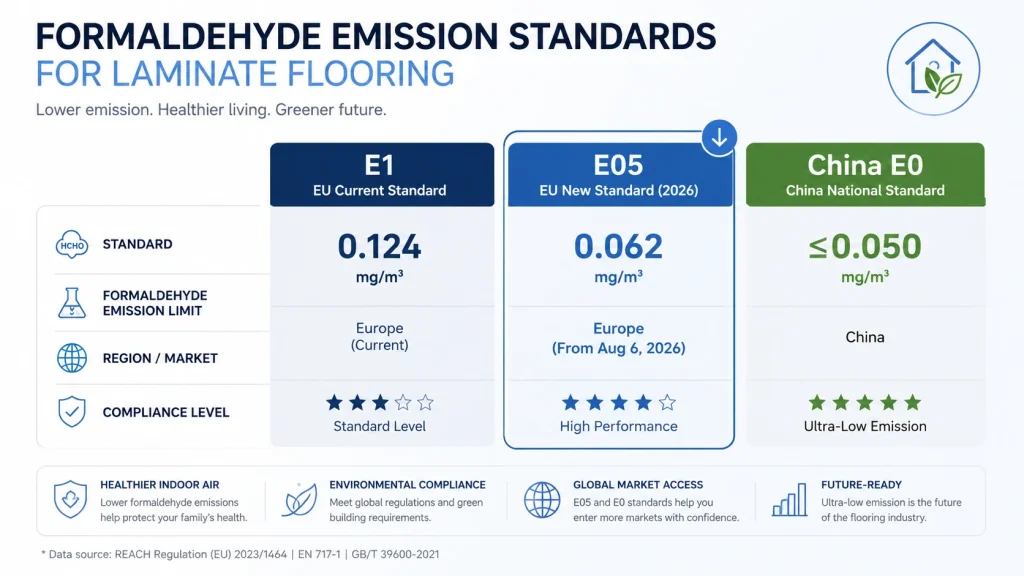
E1 vs E05: What’s the Difference?
| Standard | Formaldehyde Emission Limit | Market Position |
| E1 | 0.124 mg/m³ | Traditional EU standard |
| E05 | 0.062 mg/m³ | New EU 2026 requirement |
| China E0 | Typically ≤0.050 mg/m³ | Ultra-low emission grade |
The most important point is simple:
E05 reduces allowable formaldehyde emissions by nearly 50%.
This creates new challenges for manufacturers still relying on:
- Conventional HDF systems
- Traditional adhesive technology
- Inconsistent production control
As a result, not every E1 laminate flooring product will automatically qualify for future EU requirements.
Why Laminate Flooring Is Receiving More Attention
Laminate flooring remains one of the world’s most widely used flooring solutions because it offers:
- Wood-like appearance
- Durability
- Cost efficiency
- Easy installation
However, laminate flooring also depends heavily on:
- HDF core boards
- Resin systems
- Adhesive technology
- Surface bonding processes
These components directly affect formaldehyde emissions.
In practice, the environmental performance of laminate flooring is largely determined by the quality of the HDF core and manufacturing process behind it.
This is why professional buyers increasingly evaluate suppliers based on:
- HDF quality
- Emission testing
- Low VOC capability
- Production consistency
- Environmental certifications
rather than simply focusing on design or pricing.
However, buyers should understand that not all “E0” products offer the same performance.
Real compliance depends on:
- Stable HDF quality
- Reliable adhesive systems
- Long-term process control
- Third-party emission testing
This is why many professional buyers now request:
- EN717-1 reports
- CE certification
- EPA TSCA Title VI compliance
- VOC testing
- FSC certification
before selecting laminate flooring suppliers.
What Happens If Laminate Flooring Does Not Meet E05?
For importers and distributors, non-compliant laminate flooring may create serious business risks in future European markets.
Potential risks include:
Customs Delays or Shipment Rejection
Products that fail to meet EU formaldehyde limits may face inspection issues or import restrictions.
Increased Legal and Compliance Risks
Distributors and contractors may face higher liability if flooring products fail environmental requirements.
Loss of Market Competitiveness
As low-emission laminate flooring becomes the industry expectation, products meeting only outdated standards may gradually lose market acceptance.
Brand Reputation Damage
Environmental compliance is increasingly connected to brand trust, especially in European residential and commercial projects.
Why Some Laminate Flooring Factories May Struggle With E05
Many factories may face difficulties adapting to the new standards due to:
- Low-quality HDF boards
- Traditional resin systems
- Inconsistent production processes
- Cost-focused manufacturing models
Achieving stable E05 performance requires:
- Long-term process optimization
- Advanced adhesive technology
- Stable raw material sourcing
- Strict quality control systems
This is likely to create a clear separation between high-quality manufacturers and low-end suppliers in future global markets.
How Voyage Prepares for E05
At Voyage, our laminate flooring products are developed with a focus on:
- Stable low-emission HDF systems
- E0-grade environmental performance
- Long-term production consistency
Our products are capable of meeting upcoming EU E05 requirements, helping importers prepare for future European environmental regulations.
Explore our collection here:
Voyage Laminate Flooring Collection
How Buyers Can Choose E05-Ready Laminate Flooring
As environmental standards continue rising, selecting the right laminate flooring supplier is becoming increasingly important.
Here are several key areas buyers should evaluate:
1. Third-Party Formaldehyde Testing
Reliable suppliers should provide:
- EN717-1 testing
- SGS or Intertek reports
- Independent laboratory verification
2. HDF Core Quality
The HDF board directly affects:
- Emission performance
- Stability
- Flooring durability
Low-quality HDF may create long-term environmental risks.
3. Adhesive Technology
Modern low-emission laminate flooring increasingly relies on:
- Optimized resin systems
- Low-formaldehyde adhesives
- Advanced emission control technology
4. Sustainability Certifications
Many European buyers now also prioritize:
- FSC certification/PEFC certification
- CE certification
- Sustainable sourcing documentation
Will E05 Become the Global Standard?
There is growing evidence that Europe’s environmental regulations may influence flooring standards worldwide.
Similar environmental trends are already emerging across:
- North America
- Australia
- Middle Eastern projects
- Green building systems
- International commercial developments
As global consumers increasingly prioritize:
- Healthy indoor environments
- Sustainable materials
- Low VOC products
ultra-low emission laminate flooring may gradually become a global industry standard rather than a regional requirement.
For buyers, preparing early for E05-ready flooring may provide long-term advantages in:
- Compliance
- Market competitiveness
- Brand positioning
- Future project requirements
Final Thoughts
The EU E05 regulation is likely to reshape the future of the laminate flooring industry.
As environmental standards continue rising worldwide, low-emission laminate flooring may soon shift from a premium feature to a basic market expectation.
For buyers, understanding:
- E05 regulations
- E05 environmental standards
- HDF quality
- Low-VOC manufacturing
- CE certification
will become increasingly important when selecting long-term flooring suppliers.
Manufacturers capable of delivering stable E05-ready laminate flooring may gain significant advantages in future global markets.