Laminate Flooring Locking Systems Explained: How Click Profiles Affect Installation, Quality and Long-Term Performance
October 30, 2026
Introduction: Why the Locking System Matters in Bulk Flooring Orders
When buyers compare laminate flooring quotations, the most visible differences are usually thickness, AC rating, surface design, core specification and price. The locking system may appear to be a minor technical detail, but it affects how efficiently planks can be assembled and how consistently the joints remain connected after installation.
For an importer or distributor, an inconsistent locking profile can turn an attractive unit price into a costly shipment. Installers may spend more time correcting joints, boards may be damaged during assembly, and gaps or height differences may become visible after installation. Disputes can also arise over whether the cause was product quality, subfloor preparation or installation technique.
These risks become more significant when one shipment is distributed across multiple dealers or project sites. Buyers need a product that can be installed consistently, not simply a sample that looks good in a showroom.
A locking system should therefore be assessed as part of the complete flooring construction—not by its marketing name alone. Profile design, machining precision, HDF core properties, board dimensions, installation method and site conditions all contribute to the final result.
A premium-sounding lock cannot compensate for an unstable core or inaccurate machining. Equally, a straightforward profile may perform well when it is consistently produced and validated for its intended application.
This guide explains the main locking and installation approaches, the factors that influence joint quality, how to test samples before placing a bulk order, and what importers should confirm with their suppliers.
Explore the product range: Voyage Laminate Flooring
1. What Is a Laminate Flooring Locking System?
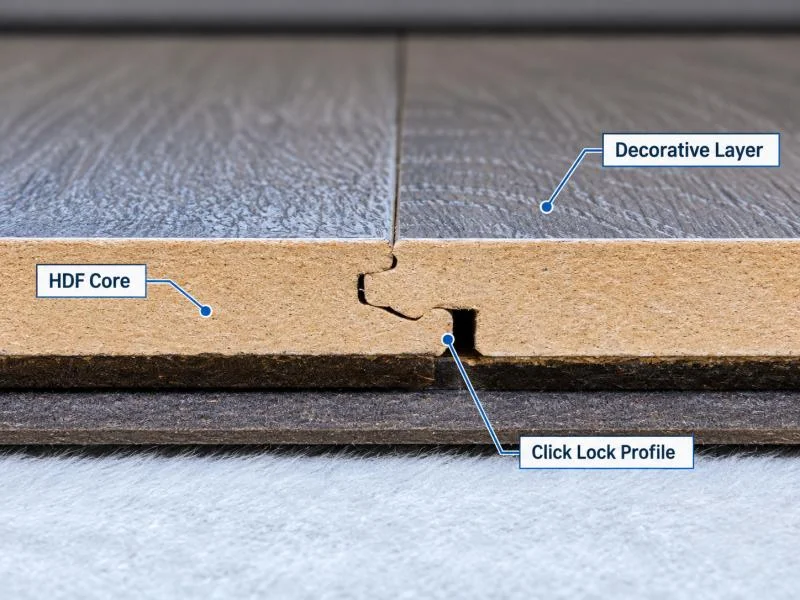
A laminate flooring locking system is the shaped connection machined into the edges of each plank. The profile allows adjacent boards to connect mechanically rather than relying on adhesive between planks. Its geometry is designed to limit horizontal separation and vertical movement at the joint while allowing the installer to assemble the floor using the specified sequence.
The locking profile is commonly machined into the HDF core. This makes core consistency important: the thin lips, grooves and supporting surfaces must withstand handling and the forces involved in installation.
If the core has weak areas, moisture variation, damaged fibers or inconsistent dimensions, a carefully designed profile may still perform inconsistently. The profile and the material around it must work together.
Descriptions in supplier quotations may include terms such as Unilin Click, Välinge Click, single lock, double lock, angle-angle or drop-lock. These labels do not all mean the same thing. Some refer to proprietary technologies, while others are general descriptions of a profile or assembly method.
When comparing quotations, ask the supplier to:
- Identify the exact locking system or profile type.
- Provide clear photographs or a drawing of the actual profile.
- Explain the installation sequence for the long and short edges.
- Confirm whether a named proprietary technology is licensed or otherwise authorized, where relevant.
- Confirm that the sample, production specification and bulk order use the same construction.
Two products are not necessarily equivalent simply because both are described as click-lock laminate flooring.
2. Common Laminate Flooring Locking System Types
Locking profiles differ in geometry and assembly sequence. Buyers should understand the basic distinctions, but the exact profile drawing and manufacturer’s installation instructions should always take precedence over a generic label.
Angle-angle locking
With an angle-angle approach, the installer tilts a plank to engage the profile and then lowers it into place. Depending on the design, angled engagement may be used on both the long and short edges.
This method can provide a controlled mechanical connection, but the installer needs sufficient clearance to angle the plank and must follow the sequence specified for the product.
For buyers supplying multiple installers or project locations, the practical question is whether the installation method can be followed reliably under expected site conditions.
Angled long edge with a drop-lock short edge
Some systems use an angled movement along the long edge and a fold-down or drop-lock movement on the short edge. The short edge is lowered into position to engage the joint.
This may be convenient where the installation sequence or room layout makes short-edge angling difficult. However, ease of assembly depends on the exact profile and correct technique. The generic term drop-lock is not a guarantee of performance.
Before approving a product, ask for the installation instructions and confirm whether the short-edge connection requires a particular angle, tapping method or installation tool.
Single-lock and double-lock descriptions
In supplier quotations, single lock and double lock may be used as commercial shorthand for different profile constructions. Usage is not always consistent between suppliers.
For this reason, buyers should not use these terms as the only basis for comparing products. Request a profile drawing or clear edge photograph, the assembly instructions and confirmation of the exact product specification.
A useful comparison should establish what the profile actually looks like, how the boards connect and how the supplier verifies consistent production.
Locking systems for herringbone and pattern flooring
Pattern formats can require different profile arrangements from standard straight-plank flooring.
Herringbone products may use left- and right-handed panels, while some systems are designed to simplify pattern installation. The locking arrangement can influence installation sequence, panel identification and the amount of skill required on site.
Before ordering pattern flooring, confirm:
- Whether left- and right-handed panels or A/B pieces are required.
- How the pieces are identified and packed.
- Whether the installation sequence differs from standard plank flooring.
- Whether replacement pieces can be supplied consistently.
- Whether the installer needs specific instructions or additional tools.
These details are especially important for distributors supplying project customers, where missing or incorrectly identified pieces can delay installation.
3. What Determines Laminate Flooring Locking System Quality?
A locking profile should not be evaluated by appearance alone. Several factors influence how consistently boards connect and how the joints behave during installation.
Related reading: How to Choose High-Quality Laminate Flooring
Profile machining accuracy
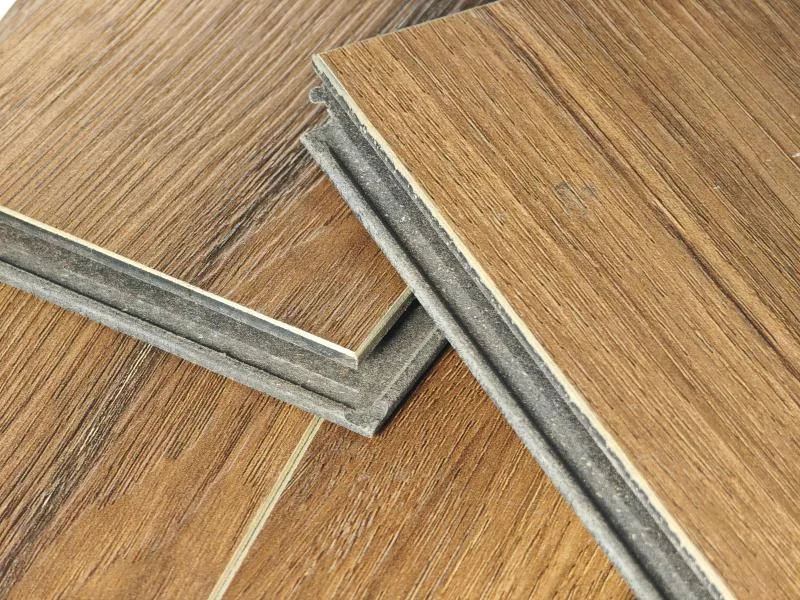
The tongue, groove, locking lip and supporting surfaces must be machined consistently.
If the dimensions vary, boards may be difficult to connect, may feel loose after assembly or may sit unevenly at the joint. Visible defects can include chipped corners, torn fibers, rough edges and irregular grooves.
Buyers should inspect several planks rather than relying on one sample. Differences between boards may indicate a need for closer production-quality checks.
However, a clean-looking profile does not automatically prove that the assembled joint will perform well. Physical assembly testing is still necessary.
HDF core consistency
The profile is only as dependable as the material around it. The HDF core must support the locking geometry without excessive damage during normal assembly.
Ask the supplier for the agreed core specification and relevant quality-control records. Confirm that the specification applies to the actual product being quoted and can be maintained across repeat production.
A density figure alone does not prove locking performance. Moisture condition, internal structure, thickness consistency and machining quality also matter.
Board dimensions and tolerances
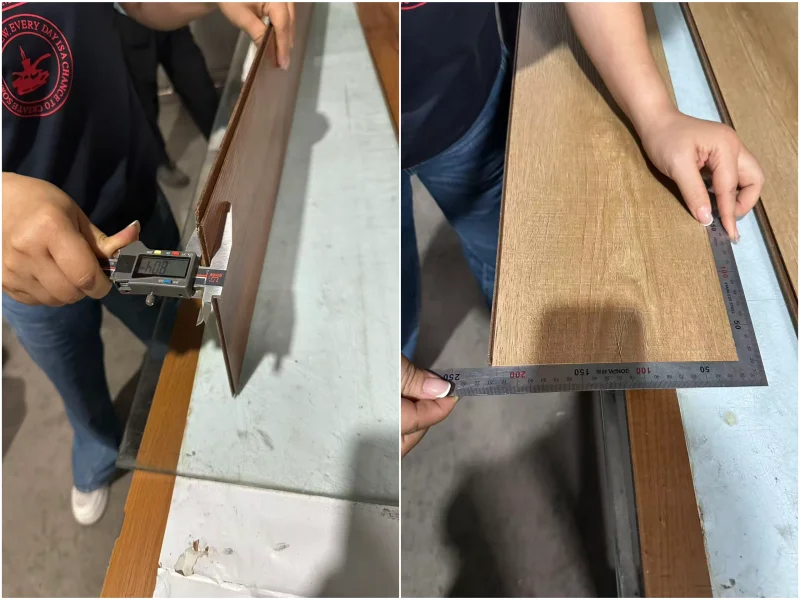
Length, width, thickness and squareness affect how planks meet. Dimensional variation can make it difficult to maintain straight rows or tight end joints, particularly across a larger installation.
The purchase specification should define nominal dimensions and tolerances rather than listing only a nominal thickness such as 8 mm or 12 mm.
For larger orders, agree on the relevant measurement method and acceptance criteria before production. This helps avoid disputes in which the buyer and supplier use different assumptions about acceptable variation.
Edge treatment and moisture-related details
Some products offer wax-treated or otherwise protected locking edges. Depending on the product design and test conditions, an edge treatment may reduce friction during assembly or provide additional protection around the joint.
Related technical guide: How to Evaluate Waterproof Laminate Flooring
It should not be treated as proof that the entire floor is waterproof.
Buyers should confirm which edges are treated, how treatment consistency is checked and what test evidence supports any moisture-resistance claim. Water resistance is a product-level performance claim and should be supported by the applicable test method and conditions.
Installation instructions and site conditions
Even a well-manufactured locking profile can be damaged by an incorrect assembly sequence, excessive force, an uneven subfloor, inadequate expansion gaps or unsuitable room conditions.
Sample testing should follow the supplier’s instructions and use a reasonably flat, clean test surface. If a problem appears, record the installation method and conditions before concluding that the profile itself is defective.
4. Common Locking Problems—and What Buyers Should Investigate
When a locking problem occurs, buyers should investigate the symptoms systematically rather than assuming that every issue is caused by the same defect.
| Observed issue | Possible contributing factors | What to verify |
| Joint is difficult to close | Incorrect assembly angle, profile variation, edge damage, debris or limited clearance | Recheck instructions and inspect several planks |
| Visible gap after assembly | Incomplete engagement, dimensional variation, damaged profile or incorrect sequence | Repeat the test with boards from multiple cartons |
| Height difference at the joint | Uneven subfloor, thickness variation, damaged locking lip or debris beneath the plank | Test on a flat base and check plank flatness |
| Chipped or broken locking edge | Excessive tapping force, damaged profile, handling damage or incorrect technique | Follow instructions and inspect edges before and after assembly |
| Joint opens after installation | Incomplete engagement, floor movement, subfloor or expansion issues, or product inconsistency | Document installation conditions and the location of the failure |
These are investigation prompts, not automatic diagnoses. For example, a visible gap may be related to an incorrectly assembled joint, but it may also reflect damaged edges or dimensional variation.
A complaint should be assessed using retained samples, photographs, installation records and batch information. Where possible, compare the affected boards with the approved sample and an unaffected production sample.
For a B2B supplier relationship, agreeing on the inspection method before shipment is usually more effective than debating causes after the floor has been installed.
5. How B2B Buyers Should Test Samples Before Ordering
Test the laminate flooring locking system on several planks from the quoted product before approving a bulk order. One successful connection is not enough to approve a bulk order. Buyers need a repeatable process that can be documented and applied to future shipments.
Step 1: Request the correct sample
Request samples from the actual construction and locking profile being quoted—not a similar product from another series.
Confirm the product code, thickness, surface design, core specification and profile type. If the supplier proposes a change before production, determine whether the revised construction needs to be approved again.
Step 2: Inspect the edges before assembly
Check several planks and, where possible, more than one carton. Inspect the long and short edges for:
- Chipped corners or damaged locking lips.
- Torn fibers and rough machining.
- Irregular grooves or visible profile differences.
- Edge damage that may have occurred during packing or transport.
Photograph any defects and record the product code and sample source.
Step 3: Follow the specified installation method
Assemble and separate the planks only as permitted by the manufacturer’s instructions. Do not force the joint with a hammer or tool unless the specified installation method requires it.
The objective is to assess the product under its intended installation conditions—not to test it using an arbitrary method that may damage the profile.
Step 4: Build a small test area
Assemble multiple planks into several rows. Check whether the joints close consistently, whether the surface remains level at the seams and whether gaps appear as the layout expands.
Test both long-edge and short-edge connections. A product may behave differently on each edge, so testing only one connection is insufficient.
Step 5: Repeat the test
Repeat the process with a second set of planks. For repeat orders, compare production samples against the retained approved sample.
Where appropriate, include samples from different cartons to help identify variation within a shipment.
Step 6: Record the results
Keep photographs of the profile before assembly and the joints after assembly. Record the product code, thickness, core specification, date and sample source.
For larger orders, buyers may request a profile drawing, production inspection record or third-party inspection. The appropriate level depends on order value, target market, product positioning and the consequences of a field complaint.
Step 7: Agree on acceptance criteria in writing
Ask the supplier to confirm:
- Which dimensions are measured.
- How many samples are checked.
- What constitutes an unacceptable defect.
- How joint closure and surface alignment are assessed.
- How nonconforming goods are documented and handled.
Avoid setting an arbitrary joint-strength threshold unless the test method and acceptance limit are agreed and relevant to the product.
The goal is to make sample approval repeatable and traceable—not simply to record that the sample “looks good.”
Discuss Your Laminate Flooring Specification with Voyage
Before placing a bulk order, share your target thickness, AC rating, locking-profile requirements, destination market and estimated quantity with Voyage. We can discuss available product specifications, sample options and bulk pricing for your project.
Explore our laminate flooring range or contact our team to discuss your requirements and request samples.
View product examples: 8mm AC4 EIR laminate flooring | 12mm AC5 EIR laminate flooring | waterproof laminate flooring with wax-sealed edges
6. How Locking Systems Fit AC3, AC4 and AC5 Product Strategies
AC rating describes the surface abrasion-resistance classification; it does not directly measure the strength of the locking profile.
A higher AC rating should not be assumed to mean easier installation or a stronger joint. Buyers should evaluate wear performance, core construction and locking quality as separate parts of the specification.
This distinction matters when building a product range for Central Asia and the Middle East, where inquiries can include value-oriented AC3 products as well as AC4 and AC5 options.
For a broader comparison, read: AC4 vs AC5 Laminate Flooring
The right choice depends on the intended application, customer expectations, local price point and applicable technical requirements.
Market-specific reading: How to Specify Laminate Flooring for Different Markets
AC3: Value-oriented and volume products
An 8 mm AC3 product may serve as an entry-level or volume SKU for suitable residential applications.
For this segment, buyers should pay particular attention to whether the locking profile is consistently manufactured and practical for the local installer base. A competitive price is commercially useful only when the product can be installed reliably and the supplier can maintain the approved specification.
AC3 should not automatically be classified as suitable for every residential or commercial application. Confirm the intended use and relevant product requirements.
AC4: Core distributor range
AC4 products may form part of a broader distributor range, depending on the target market and intended application.
In addition to surface wear performance, compare profile consistency, installation method, thickness, core specification and dimensional tolerances.
For distributors, a product that is straightforward to install and consistent across shipments may be more commercially valuable than a product with an attractive specification but an unclear quality-control process.
AC5: Selected higher-performance products
For products intended for more demanding applications, buyers should evaluate the complete construction and relevant test documentation.
Do not use AC5 as a substitute for checking locking quality, dimensional tolerance or suitability for the actual site. Surface abrasion classification and joint performance are different aspects of product evaluation.
A practical regional assortment can therefore include AC3, AC4 and selected AC5 products, provided each item has a defined use case and specification. These are possible portfolio positions, not universal rules.
Related guide: Laminate Flooring Thickness Guide: 8mm vs 10mm vs 12mm
7. What Importers Should Confirm With Suppliers
Before approving a quotation or production order, confirm the following points in the written specification.
Laminate Flooring Locking-System Procurement Checklist
- Exact locking-system name or profile type, supported by an approved photograph or drawing.
- Installation method for the long and short edges, including any special tools or tapping requirements.
- Board size, thickness and dimensional tolerances.
- HDF core specification and relevant production quality-control checks.
- Whether locking edges receive wax or another treatment, and the scope of any moisture-related claim.
- Sample approval method and criteria for joint closure, height differences, edge damage and assembly consistency.
- Confirmation that production will use the same profile, tooling setup and construction as the approved sample.
- Packaging and handling controls that protect the edges during transport.
- Batch identification, inspection records and a documented process for investigating claims.
These confirmations help align the quotation, approved sample and delivered goods.
If a supplier changes the profile or construction after sample approval, buyers should assess whether the change requires a new sample or updated acceptance criteria. A small change in a technical component can affect how the complete product is installed.
8. Why Locking Quality Matters for Landed Cost and Repeat Orders
The lowest unit price is not always the lowest-cost purchase.
If a profile is difficult to install, installers may need more time and may damage more boards. If inconsistency leads to callbacks, replacement shipments or disputes, those costs can exceed a small difference in the original quotation.
Buyers should consider the total cost of supply, including:
- Product price, freight and applicable duties.
- Incoming inspection and quality-control costs.
- Installation labor and installation-related waste.
- Claims handling, replacement goods and additional logistics.
- The potential impact of delayed project completion or dissatisfied distribution customers.
For distributors, consistency between containers can matter as much as the first sample. A product that installs well in the initial shipment but changes after a tooling adjustment or raw-material variation can create repeat-order problems.
Keep an approved sample, the written technical specification and inspection criteria together. For repeat orders, request confirmation that the locking profile and construction remain unchanged—or require reapproval if they change.
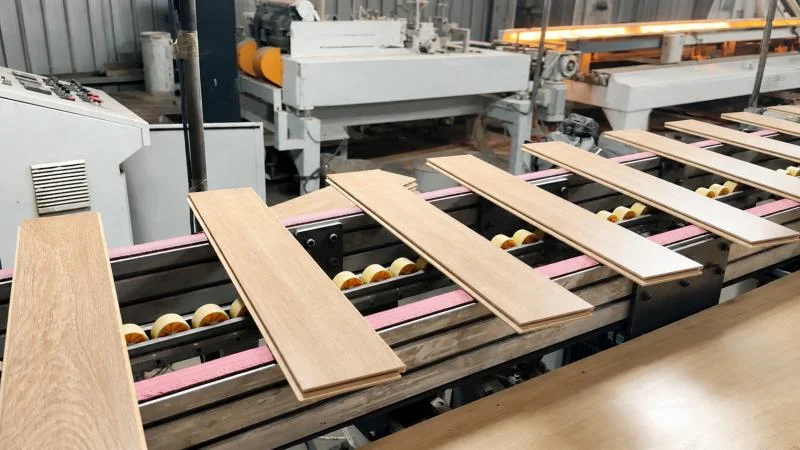
The purpose of pre-shipment quality control is not only to identify defects. It is also to reduce uncertainty between what was quoted, what was approved and what is ultimately delivered.
Frequently Asked Questions
Does a more expensive click system always perform better?
No. Performance depends on the exact profile, manufacturing accuracy, core material, dimensions and installation conditions. Compare samples and documented quality controls rather than price or system name alone.
Does AC5 laminate flooring have a stronger locking system than AC3?
Not necessarily. AC rating relates to surface abrasion resistance. Locking performance must be assessed separately through profile design, material consistency, dimensional control and assembly testing.
Does wax on the locking edge make laminate flooring waterproof?
No. Edge treatment may help protect the joint, depending on the product and test conditions, but it does not by itself establish that the entire floor is waterproof. Confirm the exact claim, test method and conditions with the supplier.
Should buyers request a profile drawing before placing a bulk order?
For larger orders, private-label programs or projects where installation claims would be costly, a profile drawing or approved close-up image is useful. It helps clarify what has been approved and makes changes easier to identify.
What is the most important pre-shipment check?
There is no single check suitable for every product. A practical minimum is to inspect profile condition and dimensional consistency, assemble multiple planks using the specified method, and document joint closure and surface alignment against agreed acceptance criteria.
Can the same locking system be used for different laminate flooring thicknesses?
A locking profile should be evaluated as part of the complete product construction. Buyers should not assume that a profile validated for one board thickness is automatically suitable for another thickness or product series. Confirm the exact profile and construction for each SKU with the supplier.
Conclusion: Specify the Lock, Not Just the Label
For laminate flooring importers and distributors, the locking system is a procurement detail with real consequences for installation efficiency, customer satisfaction and after-sales cost.
The reliable approach is to identify the actual profile, test it using the correct assembly method, verify the supporting HDF and dimensional specifications, and agree on measurable inspection criteria before mass production.
Whether the order is an 8 mm AC3 value product, an AC4 core range or a selected AC5 program, treat the locking profile as one part of a complete flooring specification. Clear documentation and repeatable sample checks help reduce ambiguity between the quotation, the approved sample and the goods delivered.
For buyers comparing suppliers, the most useful question is not simply “Which click system do you use?” It is “How do you demonstrate that this specific profile is consistent, suitable for our application and repeatable across bulk orders?”
Planning a laminate flooring order? Contact Voyage to discuss product specifications, sample approval and the technical details that should be confirmed before production.