Understanding Plywood Grades: What Does “A-Grade” Really Mean Under HPVA?
May 8, 2026
In cabinetry, interior design, and construction, hardwood plywood is more than a material – it’s the foundation of your craftsmanship. Yet many contractors find the plywood grading system confusing, especially when different standards (HPVA vs. APA) are mixed.
When you see an “A-Grade” label at Voyage, what does it actually guarantee in terms of veneer quality according to the ANSI/HPVA HP-1 standard? Why do professionals pay a premium for it? This guide gives you an accurate, standard-based answer – and helps you make profitable purchasing decisions.
The Anatomy of Premium Plywood: Core vs. Veneer
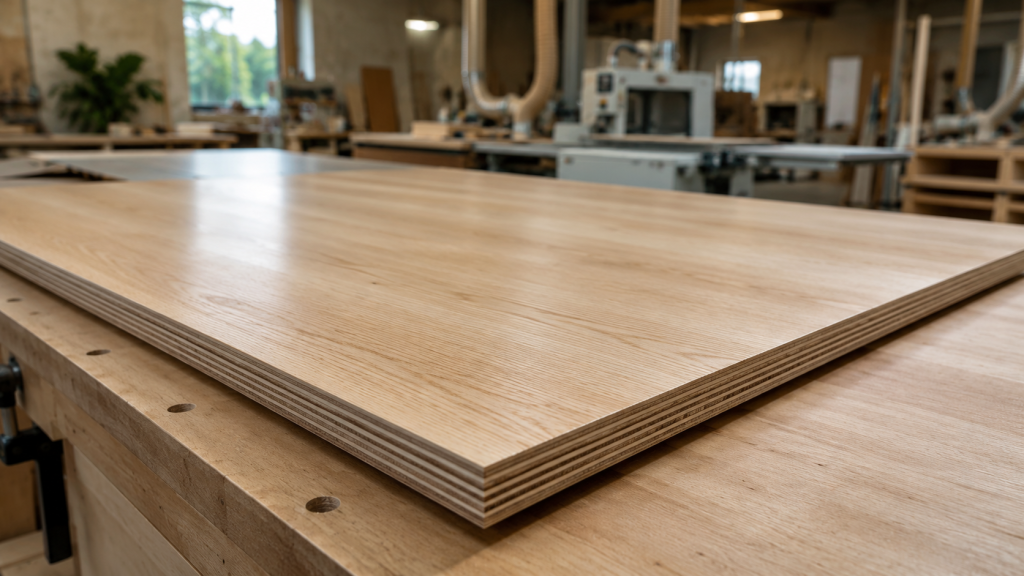
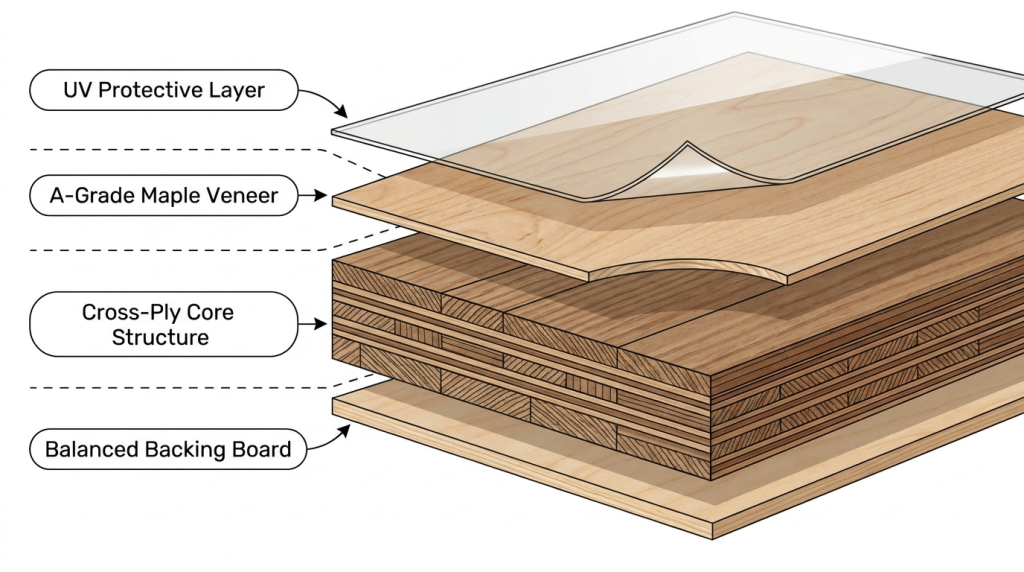
A professional-grade plywood is a balanced “sandwich”. The core determines structural performance; the veneer determines visual value.
The Core: Invisible Backbone
HDF Core (High-Density Fiberboard): Ultra-smooth, perfectly flat surface – ideal for high-end finishes.
Multi-Layer Cross-Banded Core: Alternating grain directions neutralize internal stress, keeping the panel flat under humidity changes.
Note: Core type affects flatness and screwholding power, but it does not change the HPVA grade. The grade is based solely on the face veneer’s appearance.
The Veneer: Visible Soul
The veneer is a thin slice of real hardwood (Maple, Oak, etc.). The HPVA grading system evaluates the face veneer’s visual perfection using strict quantitative limits.
HPVA Hardwood Plywood Grades: AA, A, B, C, D (and Backing Numbers)
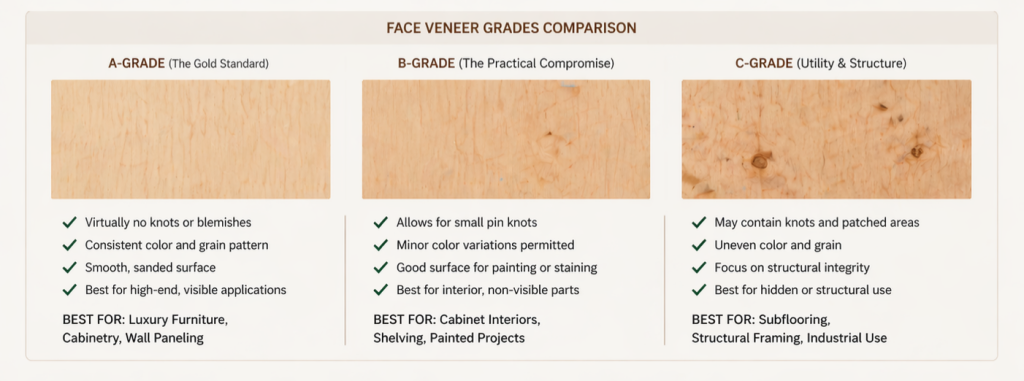
Under ANSI/HPVA HP-1, face veneers are graded AA, A, B, C, D (AA being the highest). The back is rated with numbers 1–4 (equivalent to letter grades). A typical designation looks like “A-1” (A face, 1 back).
What Does HPVA A-Grade Really Allow?
Contrary to popular belief, HPVA A-Grade is not “defect-free”. It allows very small, well-blended imperfections within strict limits. For example, in Red Oak AGrade veneer:
- Up to 12 pin knots and small burls (max 4 of them up to ¼ inch)
- Slight mineral streaks allowed
- Up to 5% sapwood
- Up to two hairline, blended splits (1/16″ × 6″ maximum)
A-Grade is a high-end cosmetic grade – perfect for visible furniture, cabinet doors, and premium wall panels. For projects demanding absolute uniformity, AA-Grade (virtually flawless) is available.
B-Grade & C-Grade: Practical Choices
B-Grade: Minor natural characteristics – small pin knots, slight color variation. Still smooth. Ideal for cabinet interiors or paint-grade work.
C-Grade: Visible knots, patches, or open defects. Structural use only, where appearance doesn’t matter.
A Critical Distinction: HPVA (Hardwood) vs. APA (Softwood)
Many people mistakenly apply APA’s softwood plywood grades (A/B/C – appearance only) to hardwood plywood. HPVA is the correct standard for hardwood plywood. Voyage’s AGrade panels strictly follow HPVA HP-1 specifications – not APA construction grades.
UV Coating (Pre-Finished): An Efficiency Layer, Not a Grade Modifier
UVcured prefinishing does not change the underlying HPVA grade – it adds durable, readytoassemble convenience on top of a quality veneer.
What is UV Coating?
A clear, hard coating applied and instantly cured by ultraviolet light on a factory line.
Why Pros Choose Prefinished Sheets:
Readytoassemble: No sanding, no staining – save ≥30% labor time.
Superior hardness: Factory-cured UV coating resists scratches and chemicals better than hand-applied finishes.
Visual consistency: Machine-applied sheen is identical on every panel.
Low VOC: Meets indoor air quality standards.
Conclusion: Why HPVA A-Grade from Voyage Is a Smart Investment
Purchasing Voyage’s HPVA A-Grade Pre-finished Plywood is not an expense – it’s an efficiency strategy.
Lower labor costs: Skip days of sanding and finishing.
Minimal waste: A-Grade face veneer means nearly every square inch is usable.
Premium reputation: Deliver a factory-grade look that commands higher reviews and prices.
Transparent standards: We follow ANSI/HPVA HP-1 – no ambiguity.
Remember:
- The core determines lifespan.
- The veneer (and its HPVA grade) determines value.
- The UV coating determines profit.