Vinyl vs Laminate Flooring: Which Is Better for B2B Flooring Projects?
September 16, 2026
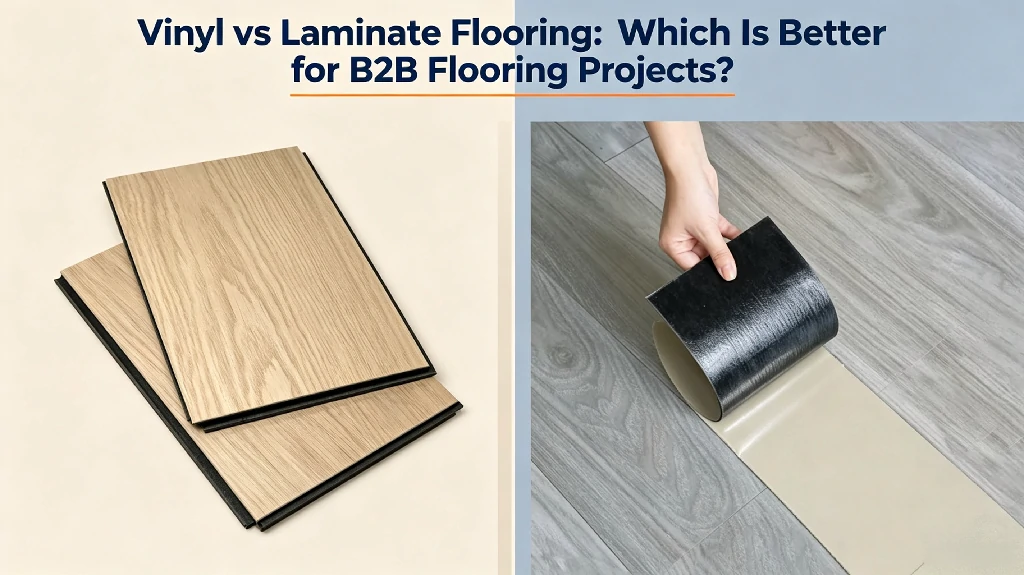
When comparing vinyl and laminate flooring for a commercial project, distribution program, or residential development, neither material fits every application. Vinyl generally offers stronger moisture tolerance and greater flexibility for wet or moisture-prone areas. Laminate provides a wood-based HDF core, strong surface abrasion resistance, and a broad range of wood and decorative designs. The right choice depends on the project environment, traffic level, installation requirements, product specifications, and target market.
For B2B buyers, the decision also involves more than selecting a floor covering for one building. Importers and distributors need consistent specifications across multiple orders. Contractors need products that match installation conditions and project requirements. Developers may prioritize appearance, durability, regulatory documentation, and procurement efficiency at the same time.
This makes a direct vinyl vs laminate flooring comparison more useful than simply asking which material is better.
Laminate flooring has also developed far beyond its early reputation as a basic alternative to wood flooring. Modern HDF laminated flooring can use synchronized embossing, multiple surface structures, different wear ratings, and moisture-resistant construction. Vinyl flooring has also expanded into several formats, including sheet, luxury vinyl tile, and rigid-core products.
The result is a market where product specifications matter more than the material name alone.
Vinyl vs Laminate Flooring: How Do Their Constructions Differ?
The first step in comparing the two materials is to understand what sits beneath the decorative surface.
Laminate flooring normally uses several layers. A decorative paper creates the visual pattern, while a protective overlay helps resist abrasion and surface wear. Beneath these layers sits the core board, commonly made from high-density fiberboard. A balancing layer supports dimensional stability.
The European Producers of Laminate Flooring describes HDF as a common laminate core material. Its high density supports the floor under regular use. Laminate products can also fall under EN 13329 performance and use classifications.
Vinyl flooring uses a different material structure. Depending on the product, construction may include a vinyl wear layer, printed design layer, backing, and other intermediate layers. ASTM F1303, for example, covers sheet vinyl flooring with backing and evaluates characteristics such as wear layer thickness, flexibility, chemical resistance, heat resistance, light resistance, and static load.
This structural difference affects how each material responds to water, impact, installation conditions, and long-term use.
HDF Laminated Flooring Construction
HDF is important because it gives laminate flooring a rigid wood-fiber core.
A typical laminate board can include:
- Protective wear layer
- Decorative design layer
- HDF core
- Balancing layer
- Mechanical locking profile
The HDF core provides the board with its structural body. Its density and manufacturing consistency influence dimensional stability, machining quality, and locking performance.
For B2B procurement, the core should therefore be evaluated alongside the surface. A decorative layer alone does not define the performance of a laminate floor.
The EPLF notes that direct-pressure laminate products typically use a high-density fiberboard core and several functional layers. Its published technical information also shows laminate products across different thicknesses and abrasion classes.
Vinyl Flooring Construction
Vinyl flooring does not rely on a wood-fiber core. Its construction varies considerably by product type.
A vinyl product may include:
- Protective wear layer
- Printed decorative layer
- Vinyl or polymer core
- Reinforcement or stabilizing layer
- Backing layer
This structure allows manufacturers to engineer different levels of flexibility, dimensional stability, impact resistance, and moisture resistance.
For B2B buyers, this creates an important procurement point. “Vinyl flooring” covers a broad product family, so a comparison should always identify the specific construction and performance specification.
How Do Laminate and Vinyl Compare for Commercial Applications?
Commercial projects place different demands on flooring than ordinary residential rooms.
Retail stores, offices, hotels, restaurants, apartments, and public spaces may experience frequent foot traffic, rolling loads, furniture movement, spills, cleaning, and repeated maintenance.
Laminate flooring uses established load and abrasion classifications. Under EN 13329, commercial use classes include 31, 32, 33, and 34, with higher classes intended for increasingly demanding applications.
This classification system gives buyers a practical starting point when evaluating laminate products for projects.
Vinyl products use different standards and specifications. ASTM standards for resilient flooring cover characteristics such as abrasion, puncture, impact resistance, flexibility, chemical resistance, and heat or light stability.
The important point is that the two materials should not be compared using one universal performance scale.
| Performance consideration | Laminate flooring | Vinyl flooring |
|---|---|---|
| Core construction | Usually HDF or similar wood-fiber board | Polymer or vinyl-based construction |
| Surface design | Wood, stone, tile, parquet, decorative patterns | Wood, stone, tile, abstract and decorative patterns |
| Water tolerance | Product-dependent | Generally strong, depending on construction |
| Abrasion evaluation | Often expressed through AC ratings and use classes | Depends on product specification and applicable standard |
| Structural rigidity | Generally high | Varies from flexible to rigid-core formats |
| Moisture-prone applications | Requires suitable construction | Often suitable when properly specified |
| Wood appearance | Strong visual reproduction | Strong visual reproduction |
| Floating installation | Common | Depends on product format |
| Commercial specification | Use class and technical datasheet | Product standard and technical datasheet |
| B2B procurement focus | Core, wear class, thickness, locking system, emissions | Wear layer, construction, thickness, dimensional stability |
Table 1. Key technical considerations when comparing laminate and vinyl flooring for B2B applications.
The table illustrates why project specifications should come before material preferences.
For example, a hotel corridor with heavy pedestrian traffic may require a different laminate specification than a residential bedroom. Likewise, a ground-floor retail project with frequent wet cleaning may require a vinyl construction designed for that environment.
Traffic Levels Matter More Than Product Names
A common purchasing mistake is to compare products by category instead of by specification.
A buyer may ask whether laminate or vinyl is more durable. A more useful question is whether the selected product meets the expected traffic and maintenance conditions.
For laminate, wear class provides an established reference point. Class 31 is associated with lighter commercial applications, while classes 32 and 33 cover progressively heavier use. Class 34 addresses very intensive commercial environments.
For vinyl, buyers should examine the product’s specific wear layer, construction, applicable standard, and intended service environment.
This distinction becomes particularly important for distributors. A product range should contain clearly differentiated specifications instead of relying only on different colors or patterns.
Which Flooring Performs Better in Moisture-Prone Areas?
Moisture is one of the clearest differences between laminate and vinyl.
Traditional laminate flooring contains a wood-fiber core. Water exposure can therefore become a concern if moisture reaches vulnerable joints or the core material. However, modern laminate products can incorporate moisture-resistant cores, edge treatments, and sealing technologies.
This means buyers should avoid treating all laminate flooring as equally water-sensitive.
For kitchens, entrances, utility spaces, and other areas where occasional moisture may occur, product construction becomes critical. For areas with more demanding moisture conditions, a suitable waterproof laminate specification may be considered.
Voyage offers a dedicated waterproof laminate flooring range for applications where moisture resistance forms part of the product specification.
Vinyl flooring has an inherent advantage in many moisture-related applications because its polymer-based construction does not rely on an HDF core. However, water resistance still depends on the complete flooring system.
The joints, subfloor, installation method, backing, and perimeter detailing all influence the final result.
Moisture Should Be Evaluated at the System Level
A flooring board does not operate independently from its installation environment.
For a commercial project, buyers should consider:
- Expected moisture exposure
- Cleaning methods
- Joint construction
- Subfloor conditions
- Installation system
- Edge treatment
- Manufacturer installation requirements
A product described as water-resistant should not automatically be treated as suitable for every wet environment.
The technical datasheet should define the intended application.
Example: Hotel Renovation
Consider a hotel renovation involving guest rooms, corridors, bathrooms, and entrance areas.
The guest rooms may prioritize wood appearance, acoustic comfort, and resistance to regular foot traffic. A suitable laminate specification can meet those requirements.
Bathrooms and areas with direct water exposure may require a different flooring material or a specifically engineered waterproof product.
The entrance zone presents another challenge. It receives high traffic and may carry water and grit from outside.
A single material does not necessarily provide the most suitable solution for every room.
This is why commercial flooring schedules often divide products by application instead of specifying one material throughout an entire building.
How Do Laminate and Vinyl Compare in Design and Wood Appearance?
Design remains an important purchasing factor, especially for residential developers, hospitality projects, retail interiors, and flooring distributors.
Both laminate and vinyl can reproduce wood, stone, concrete, and other surface patterns. The difference lies partly in how the material creates its visual and tactile effect.
Laminate flooring uses a decorative paper beneath a protective surface. Modern printing and embossing technologies can create detailed grain patterns and synchronized textures.
Embossed-in-register, or EIR, technology aligns surface texture with the printed design. This can make a wood pattern feel more consistent between visual appearance and surface texture.
Vinyl flooring can also reproduce wood patterns with printed films and surface textures. Some products use high-definition decorative layers and embossed surfaces.
For buyers building a product range, the decision should therefore consider more than the realism of the pattern.
Product Range Architecture
A distributor may need several collections to address different market segments.
For example:
- Traditional oak and walnut visuals for mainstream residential projects
- Herringbone patterns for renovation and hospitality
- Stone designs for contemporary interiors
- Dark wood patterns for commercial spaces
- Light oak designs for larger residential developments
A laminate range can support these categories through different decorative papers, surface textures, dimensions, and edge profiles.
Voyage’s classic laminate flooring collection can serve projects that require conventional wood-oriented laminate designs.
The important B2B consideration is range consistency. A distributor may need several designs that share the same technical construction, thickness, locking profile, packaging format, and compliance documentation.
This simplifies inventory planning.
What Should B2B Buyers Check Before Ordering Laminate Flooring?
For commercial procurement, flooring selection should move from appearance to technical verification.
A buyer sourcing wholesale laminate flooring should review the product specification before comparing unit prices.
1. Core Material
Check whether the core uses HDF, MDF, or another engineered board.
For HDF laminated flooring, ask for the core density and relevant technical data when these specifications affect the intended application.
2. Thickness
Common laminate thicknesses vary by product range and application.
A thicker board does not automatically mean better performance. Buyers should consider thickness together with core density, surface construction, locking profile, and installation conditions.
3. Wear Rating
AC ratings provide useful information for laminate surface abrasion.
However, the AC rating should not become the only purchasing criterion. EN 13329 considers multiple characteristics when defining laminate flooring performance and use classes.
4. Locking System
The locking profile affects installation speed, joint integrity, replacement, and installation requirements.
For large projects, consistent locking geometry also helps reduce installation variation between batches.
5. Surface Structure
Surface treatment affects appearance, tactile feel, cleaning, and scratch visibility.
Options may include smooth, matte, embossed, EIR, or other finishes.
6. Moisture Resistance
Ask whether the product has:
- Water-resistant HDF
- Edge sealing
- Wax treatment
- Moisture-resistant coating
- Waterproof construction
- Defined water-resistance test data
Do not treat these terms as interchangeable.
7. Compliance Documentation
For export-oriented B2B procurement, documentation can influence market access.
For example, EPA rules cover formaldehyde emissions from regulated composite wood products in the United States. EPA states that applicable composite wood products and finished goods containing regulated composite wood products must meet relevant TSCA Title VI requirements.
Buyers should therefore request the specific compliance documents required for their destination market.
8. Packaging and Logistics
Flooring is a high-volume product.
Packaging affects warehouse handling, container loading, transport damage, and inventory identification.
A B2B supplier should be able to provide clear information on:
- Carton dimensions
- Boards per carton
- Coverage per carton
- Cartons per pallet
- Pallets per container
- Net and gross weight
- Labeling options
- Private-label packaging
These details influence the real procurement cost more than the quoted square-meter price alone.
Request laminate flooring specifications, samples, and bulk supply information from Voyage
How Does Wholesale Laminate Flooring Fit Large-Volume Procurement?
For distributors and project contractors, wholesale purchasing involves more than ordering a large quantity of boards.
A successful wholesale program requires consistency across repeated production batches.
Color consistency is one example. If a distributor orders the same design several times, visual variation between production batches can create inventory problems.
Dimensional consistency also matters. Differences in board size, thickness, locking geometry, or edge treatment can affect installation.
This becomes even more important for bulk laminate flooring orders supporting multiple construction sites.
Bulk Purchasing Requires Specification Control
A buyer should establish a written product specification before placing a large order.
That specification can include:
- Product name and design
- Core material
- Thickness
- Dimensions
- Wear class
- Surface finish
- Edge profile
- Locking system
- Moisture resistance
- Packaging
- Labeling
- Compliance requirements
- Inspection requirements
This document becomes a reference for future purchase orders.
It also reduces the risk of comparing different products under the same commercial description.
Example: Multi-Property Residential Development
Imagine a developer sourcing flooring for 12 apartment buildings.
The project requires 80,000 m² of flooring across several phases.
The procurement team may initially compare laminate and vinyl based on price per square meter. That approach leaves out several important variables.
The team should also consider installation method, replacement requirements, expected traffic, moisture exposure, design consistency, packaging, lead time, and compliance.
If the same laminate specification works across bedrooms, living areas, corridors, and other suitable spaces, procurement can become more standardized.
That can reduce the number of SKUs and simplify inventory management.
However, areas with significantly different moisture or performance requirements may still need another flooring category.
The best procurement strategy is therefore not necessarily to choose one material for every room. It is to match each material to the conditions it needs to handle.
Vinyl vs Laminate Flooring: Which Factors Should Decision-Makers Prioritize?
A practical comparison should consider the project from several angles.
Moisture Environment
If the project has frequent moisture exposure, vinyl may offer a simpler material approach in many applications.
If the project requires a wood-based floor with moisture-resistant construction, specialized laminate products may also be suitable.
Appearance
Both categories can reproduce wood and stone designs.
Laminate remains strongly associated with wood-based visual aesthetics because its decorative construction works naturally with detailed wood patterns.
Traffic
Laminate buyers can use EN 13329 use classes and abrasion classifications as important reference points.
Vinyl buyers should examine the product’s wear layer and applicable performance standards.
Installation
Laminate is commonly installed as a floating floor with mechanical locking systems. EPLF describes floating installation and mechanical locking as established features of modern laminate flooring.
Vinyl installation varies according to product type. Some products use click systems, while others use adhesive or other installation methods.
Maintenance
Both materials can offer relatively straightforward routine cleaning when installed and maintained according to manufacturer instructions.
However, cleaning chemicals, standing water, furniture loads, and maintenance equipment should match the product specification.
Market Positioning
For distributors, the material should also fit the target market.
Laminate may suit a product portfolio focused on wood appearance, HDF construction, and traditional flooring formats.
Vinyl may fit ranges focused on moisture resistance, resilient construction, or specific commercial applications.
The decision should therefore connect product specifications with actual market requirements.
FAQ: Vinyl vs Laminate Flooring
Is laminate flooring better than vinyl flooring?
Neither material is universally better. Laminate can provide a rigid HDF-based structure, strong abrasion performance, and extensive wood-look designs. Vinyl can provide strong moisture tolerance and flexible construction options. The application should determine the specification.
Is HDF laminated flooring suitable for commercial projects?
Yes, suitable HDF laminated flooring can be specified for commercial applications. Buyers should check the applicable use class, abrasion rating, thickness, core construction, locking system, and manufacturer technical data.
Is laminate flooring waterproof?
Not all laminate flooring is waterproof. Conventional laminate uses a wood-fiber core, so moisture resistance depends on the specific construction. Waterproof laminate products may use enhanced core materials and edge treatments.
Which flooring is easier to install?
Installation depends on the product design. Many laminate products use floating click systems. Vinyl products may use click, adhesive, loose-lay, or other systems. Buyers should evaluate the installation method together with the subfloor and project requirements.
Does thicker laminate flooring always perform better?
No. Thickness is only one technical variable. Core density, surface construction, locking geometry, wear class, dimensional stability, and installation conditions also affect performance.
Is laminate flooring suitable for high-traffic commercial areas?
Some laminate products are designed for high-traffic commercial applications. EN 13329 provides commercial use classifications, including classes 31 through 34. The correct class depends on the expected level of use.
What should I request before buying bulk laminate flooring?
Request a technical datasheet, product sample, core information, thickness and dimensions, wear classification, installation instructions, packaging details, compliance documentation, and quality inspection information.
How should distributors compare laminate flooring suppliers?
Compare suppliers using consistent technical criteria. Review product specifications, production consistency, customization options, packaging, documentation, lead times, minimum order quantities, and quality-control procedures. Unit price should form only one part of the comparison.
Conclusion: Choosing the Right Flooring for the Project
The vinyl vs laminate flooring decision becomes clearer when buyers stop treating the materials as interchangeable categories.
Vinyl generally has an advantage where moisture exposure, resilient construction, and flexible product formats are central requirements. Laminate can provide a rigid HDF-based construction, established abrasion and use classifications, and a broad range of wood-oriented designs.
For B2B procurement, the most important step is to define the application before selecting the product.
A residential bedroom, hotel corridor, retail store, office, apartment development, and moisture-prone entrance do not place the same demands on flooring.
For laminate procurement, buyers should examine the HDF core, wear class, thickness, locking system, surface structure, moisture resistance, emissions documentation, packaging, and supply consistency.
For larger programs, bulk laminate flooring should be evaluated as a complete supply solution rather than as a simple price-per-square-meter purchase.
Voyage supplies HDF laminated flooring for residential and commercial applications, with product options covering different thicknesses, wear ratings, surface treatments, patterns, and moisture-resistant constructions. The company provides wholesale and bulk supply, together with OEM and ODM options for buyers who require customized specifications, packaging, or product designs. Voyage’s product portfolio includes wood-look, herringbone, chevron, parquet, and other laminate formats. Its published range also includes options with HDF cores, EIR surface textures, and AC3 to AC6 wear ratings.
For importers, distributors, contractors, and project buyers, the objective is not simply to select between vinyl and laminate. It is to identify the flooring construction that matches the environment, performance requirements, installation system, and procurement plan.
References
- European Producers of Laminate Flooring, “Laminate A-Z” and technical information on laminate construction, HDF, EN 13329, wear classes, and installation.
https://eplf.com/en/laminate/laminate-a-z - European Producers of Laminate Flooring, “About Laminate,” including the development of laminate flooring and EN 13329 use classifications.
https://eplf.com/en/laminate/about-laminate - ASTM International, ASTM F1303, Standard Specification for Sheet Vinyl Floor Covering with Backing.
https://store.astm.org/f1303-04r21.html - U.S. Environmental Protection Agency, “Formaldehyde Emission Standards for Composite Wood Products.”
https://www.epa.gov/formaldehyde/formaldehyde-emission-standards-composite-wood-products - U.S. Environmental Protection Agency, “Questions and Answers Regarding Laminate Flooring.”
https://www.epa.gov/formaldehyde/questions-and-answers-regarding-laminate-flooring