How Should B2B Buyers Compare Hardwood vs. Laminate Flooring for Wholesale and Project Supply?
October 14, 2026
Hardwood and laminate flooring serve different market needs, so B2B buyers should compare them by material structure, lifecycle cost, durability, maintenance, and target application. Hardwood offers natural wood grain and the option to refinish many solid wood floors. Laminate provides a printed wood appearance, a factory-finished wear surface, and a broad range of designs and price points. For importers, distributors, and project contractors, the right choice depends on customer expectations, installation conditions, purchasing budgets, and expected service requirements. Hardwood may suit projects that prioritize natural materials and long-term renovation potential. HDF Laminated Flooring can be a practical alternative for residential developments, rental properties, retail spaces, and commercial interiors where consistent specifications and controlled procurement costs matter. A structured comparison helps buyers select products that fit their markets rather than relying on appearance or initial price alone.
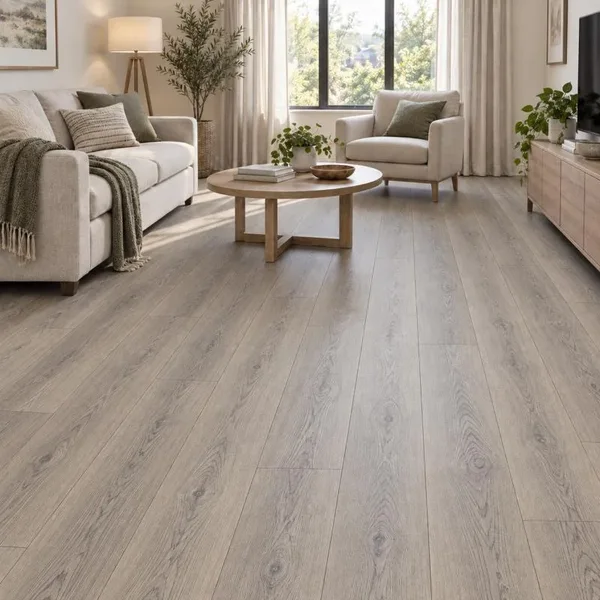
1. What Are the Main Differences Between Hardwood and Laminate Flooring?
The first step is to understand how each flooring type is constructed. Although both can reproduce the look of timber interiors, their material composition and performance characteristics differ considerably.
Hardwood flooring: Natural material with refinishing potential
Hardwood flooring uses real wood as its primary flooring material. Solid hardwood boards consist of wood throughout their thickness, while engineered hardwood combines a real wood surface layer with a multilayer core.
These two formats should not be treated as identical. Solid hardwood generally offers greater refinishing potential, depending on its thickness and condition. Engineered hardwood can provide improved dimensional stability through its layered construction, although refinishing options depend on the thickness of its real wood veneer.
Wood flooring also varies by species, grade, surface treatment, board dimensions, and installation method. Oak, maple, walnut, and other species have different grain patterns, hardness levels, and price structures. Buyers should evaluate these factors when comparing quotations from different suppliers.
Natural variation is another important consideration. Differences in grain, knots, color, and moisture response contribute to the appearance of real wood. However, they can also affect sorting requirements and the consistency of finished projects.
For distributors, hardwood is worth considering when the target market values natural materials, established timber aesthetics, and the possibility of refinishing. The product specification must still match the intended environment and maintenance expectations.
Laminate flooring: A layered product engineered for everyday use
Laminate flooring recreates the appearance of wood through a decorative image layer protected by a wear-resistant surface. A typical product includes four functional components:
- Wear layer: Protects the decorative surface against everyday abrasion and surface wear.
- Decorative layer: Reproduces timber grain, color, and other design details.
- Core board: Often uses high-density fiberboard, or HDF, to provide structural support.
- Balancing layer: Helps stabilize the panel and supports the overall construction.
Manufacturers combine these layers under controlled pressure and temperature. The resulting boards offer repeatable designs, defined dimensions, and factory-applied surface finishes.
HDF Laminated Flooring uses a high-density fiberboard core. Its performance depends on several factors, including core quality, surface construction, locking profile, dimensional tolerances, and moisture resistance. HDF density alone cannot establish overall product quality.
Laminate is not simply a photograph of wood attached to a board. Its wear layer, core, joints, and balancing layer work together as a flooring system. Buyers should therefore assess the complete construction rather than judging a sample by its decorative surface alone.
For wholesale programs, laminate also offers practical advantages in product planning. Suppliers can provide coordinated colors, repeatable surface patterns, and different specifications for residential or commercial applications. These characteristics can help distributors maintain consistent product lines across multiple shipments.
2. How Do Cost, Durability, and Maintenance Compare?
The initial purchase price is only one part of the flooring decision. Buyers should consider installation costs, routine care, replacement requirements, and the consequences of product failure over the intended service period.
Initial purchase and total project cost
Hardwood pricing depends on species, grade, construction, finishing, dimensions, and sourcing conditions. Installation may also require specialized labor, subfloor preparation, and additional finishing work, depending on the product.
Laminate generally provides a more accessible route to a timber-style appearance. Its factory-finished surface and click-lock installation options can simplify project planning. Actual savings depend on local labor rates, underlay requirements, substrate conditions, and the selected product specification.
For importers, landed cost is more useful than the factory quotation alone. A meaningful calculation should include:
- Unit price and order quantity.
- Packaging, freight, insurance, duties, and local handling.
- Installation accessories and labor assumptions.
- Expected wastage, replacement stock, and after-sales costs.
For example, a distributor supplying several apartment developments may prefer laminate when the project requires a coordinated appearance across many units. Standardized specifications can simplify purchasing and stock allocation. A boutique residential project may instead accept a higher material cost for the natural variation and refinishing potential of hardwood.
Neither option guarantees a lower lifecycle cost in every market. Buyers need to evaluate the full project budget and the expected use conditions.
Surface durability and resistance to damage
Laminate performance depends on its wear layer, core, locking system, and suitability for the intended traffic level. Surface abrasion resistance is particularly relevant for spaces with frequent foot traffic, furniture movement, or regular cleaning.
Buyers often use AC ratings when comparing laminate products. These ratings relate to abrasion resistance under standardized testing. They should not be interpreted as a complete measure of impact resistance, moisture tolerance, scratch resistance, or overall lifespan.
Hardwood performance varies by species, finish, board construction, and maintenance. Some species resist indentation better than others, but even hard timber can develop scratches, dents, or finish wear. Deep damage may require sanding, repair, or board replacement.
A laminate surface can also suffer damage. Unlike many solid hardwood floors, conventional laminate generally cannot be sanded and refinished to restore a worn decorative layer. Damaged boards may need replacement, subject to installation access and product availability.
Commercial buyers should therefore assess the type of wear likely to occur. Rolling chairs, concentrated loads, grit, dropped objects, and heavy furniture can affect flooring in different ways. A product’s technical documentation should address the relevant performance requirements.
Cleaning and long-term maintenance
Both flooring types require suitable cleaning procedures. However, their surface finishes and repair options create different maintenance requirements.
Laminate usually needs routine dust removal and occasional cleaning with a well-wrung mop. Excess water can enter joints or damage a moisture-sensitive core. Buyers should confirm the manufacturer’s approved cleaning methods and avoid assuming that every laminate product is waterproof.
Hardwood maintenance depends on the finish and construction. Owners may need to renew surface treatments or refinish the floor after prolonged wear. Solid hardwood can often accommodate sanding, while engineered hardwood has limits determined by its top wood layer.
For property managers, maintenance planning should reflect the expected replacement cycle, cleaning resources, and availability of matching products. For distributors, supplying clear care instructions can reduce misuse and help manage customer expectations.
Table 1. Hardwood vs. laminate flooring: B2B comparison
| Evaluation factor | Hardwood flooring | Laminate flooring |
|---|---|---|
| Main construction | Solid wood or engineered wood with a real wood surface | Decorative layer, wear layer, core board, and balancing layer |
| Appearance | Natural grain and variation | Printed designs with repeatable patterns |
| Initial material cost | Often higher, depending on species and construction | Often lower for comparable wood-look applications |
| Surface wear | Depends on species and finish | Depends on wear layer and product specification |
| Refinishing | Possible for suitable products, subject to thickness and condition | Generally not suitable for sanding and refinishing |
| Moisture response | Wood expands and contracts with changing moisture conditions | Conventional HDF cores can swell after moisture ingress |
| Installation | Method varies by solid or engineered construction | Often uses a floating click-lock system |
| Routine care | Requires finish-appropriate cleaning and maintenance | Usually requires straightforward cleaning with limited moisture |
| Design consistency | Natural variation is part of the material | More repeatable color and pattern across production batches |
| Common market fit | Projects emphasizing real wood and refinishing potential | Projects emphasizing design consistency, cost control, and practical maintenance |
The table provides a general comparison rather than a universal performance ranking. Product construction, installation quality, environmental conditions, and manufacturer instructions can change the outcome.
3. Which Flooring Type Fits Residential and Commercial Projects?
The best choice depends on the environment, traffic patterns, customer expectations, and project budget. B2B buyers should translate these requirements into a clear product specification before requesting quotations.
Residential developments and rental properties
Laminate can suit apartment developments, rental housing, and renovation programs that require a consistent wood-look finish. Buyers can coordinate colors across multiple units and choose product specifications that match expected household use.
For example, a developer fitting out 120 apartments may need one main oak-style design and a second color for selected units. A coordinated laminate range can simplify procurement and reduce the number of separate product lines required.
Hardwood may be more appropriate for higher-budget residential projects where buyers value real wood, natural grain, and the potential to renew the surface. Engineered hardwood may also be considered where its construction better matches the project’s installation conditions.
The decision should account for the intended tenant profile, local resale expectations, maintenance arrangements, and replacement strategy. A lower initial price does not automatically make one product more economical over the building’s full operating period.
Retail, hospitality, and office environments
Commercial projects require more careful attention to traffic, furniture loads, cleaning routines, and maintenance access. A decorative surface alone cannot establish whether a product is suitable for a demanding environment.
Buyers should check the declared use class, abrasion rating, dimensional tolerances, locking system, and any applicable test reports. They should also confirm whether the selected product is approved for the specific environment and installation method.
A product such as commercial grade laminate flooring may be worth evaluating for suitable commercial interiors. The exact application should still match its documented specifications. Buyers should not assume that the term “commercial grade” guarantees suitability for every retail, hospitality, or office setting.
Some projects may require additional performance evidence for rolling loads, impact, fire classification, slip resistance, or acoustic performance. These requirements should be addressed during product selection rather than after an order has been placed.
Decorative layouts and design-led projects
Flooring patterns influence both the visual result and installation requirements. Hardwood can form traditional parquet layouts, while laminate can reproduce similar geometric arrangements through printed designs and shaped panels.
Parquet style flooring can support projects that need a patterned timber appearance without using individual solid wood blocks. This approach may help distributors expand their design range while maintaining a coordinated laminate product portfolio.
Herringbone is another example. The pattern requires careful alignment and appropriate installation planning. A herringbone pattern wood flooring option can provide a decorative alternative for residential interiors, subject to its declared use class and installation instructions.
For patterned products, buyers should confirm the board dimensions, locking arrangement, installation direction, and quantity calculation method. Patterned layouts may also generate more offcuts than straightforward plank installations. Including an appropriate waste allowance can prevent shortages during installation.
4. What Should Importers and Distributors Check Before Buying Wholesale Laminate Flooring?
Wholesale purchasing requires a different evaluation process from choosing flooring for a single property. Buyers need to consider specification consistency, supply planning, packaging, documentation, and the cost of managing inventory.
Define the required product specification
Before requesting quotations, prepare a specification sheet that identifies the intended application and the performance requirements. This makes supplier comparisons more meaningful and reduces the risk of receiving quotations for products with different constructions.
Key items include:
- Total thickness and plank dimensions.
- Core material and relevant technical characteristics.
- Abrasion rating and declared use class.
- Surface texture, decor, gloss level, and edge treatment.
- Locking profile and installation requirements.
- Moisture-related performance and applicable limitations.
- Formaldehyde emissions documentation and relevant compliance requirements.
- Packaging format, labeling, and pallet configuration.
Thickness should not be used as a standalone quality indicator. A thicker panel does not automatically offer better abrasion resistance, a stronger locking system, or greater moisture tolerance. Buyers should assess each property against the intended application.
Likewise, product names such as “commercial,” “water-resistant,” or “heavy-duty” should be supported by specific technical information. Request test reports, declarations, or other relevant documentation where the project or destination market requires them.
Compare quotations on an equivalent basis
When comparing wholesale laminate flooring suppliers, confirm that each quotation covers the same technical specification. Two products with similar colors may differ in core construction, surface performance, tolerances, packaging, or certification.
A practical quotation comparison should include unit price, minimum order quantity, lead time, production capacity, payment terms, packaging, and shipping arrangements. Buyers should also clarify whether the quotation covers samples, inspection, spare material, and customized packaging.
Direct wholesale laminate flooring may reduce intermediary costs when buyers purchase directly from a suitable manufacturer or supply partner. However, the lowest quoted price is not necessarily the lowest landed cost. Freight, duties, minimum order requirements, quality variation, and after-sales support can affect the final result.
For example, a distributor may receive two offers for visually similar 8 mm laminate flooring. One supplier offers a lower price but provides limited technical documentation and inconsistent carton labeling. Another supplies complete specifications and clear batch identification. The second option may reduce receiving errors and make future replenishment easier, even if the unit price is higher.
Buyers should compare the total commercial offer rather than selecting a supplier on price alone.
Plan bulk orders and inventory requirements
Bulk laminate flooring purchases can improve unit economics when order volumes align with actual demand. Yet larger orders also increase inventory exposure, storage requirements, and the cost of slow-moving designs.
Before placing an order, estimate demand by color, thickness, use class, and customer segment. Consider whether the product will serve one large project or remain in stock for ongoing distribution. These two purchasing models require different inventory strategies.
For project orders, confirm the total installation area and add a suitable allowance for cutting waste, damaged boards, and future repairs. The allowance should reflect the layout, room geometry, installation method, and project specifications rather than a universal percentage.
For stock programs, prioritize designs with clear market demand and establish reorder thresholds. Too many similar colors can fragment inventory and make replenishment less efficient. A focused assortment can be easier to manage while still covering the main preferences of the target market.
Buyers should also confirm color and batch control procedures. Where a project requires consistent flooring across several deliveries, ask how the supplier manages production batches and whether sufficient material can be reserved for the order.
Check quality control and shipment readiness
A sound procurement process covers more than the appearance of a sample. Before confirming production, buyers should agree on the approved sample, technical specifications, inspection criteria, and packaging requirements.
Inspection may cover dimensions, thickness, surface defects, edge quality, locking profiles, decor consistency, and carton labeling. The inspection plan should reflect the product specification and the consequences of defects in the destination market.
For HDF products, buyers should also review relevant core and moisture-related performance data. Storage and transport conditions matter because prolonged exposure to moisture can damage flooring components and packaging.
Before shipment, verify the order quantity, carton marks, pallet configuration, shipping documents, and any destination-specific labeling requirements. Clear records can support receiving inspections and simplify the resolution of discrepancies.
A supplier’s ability to repeat an approved specification is especially important for distributors. The first order establishes the baseline, while subsequent orders determine whether the product can remain a reliable part of the range.
5. How Can Buyers Make the Final Decision?
A practical selection process starts with the project rather than the material name. Hardwood and laminate each have strengths, but neither is automatically the better choice for every application.
Use a decision framework
Buyers can narrow the options by answering five questions:
- What does the target customer value most: natural wood, design consistency, purchase price, or maintenance requirements?
- What traffic, furniture loads, cleaning routines, and environmental conditions will the floor experience?
- Does the project require real wood, or can a wood-look decorative surface meet the design brief?
- Which technical standards, emissions requirements, and installation conditions apply?
- Can the supplier provide consistent specifications, reliable replenishment, and appropriate documentation?
If real wood and refinishing potential are central to the project, compare solid and engineered hardwood options. If consistent designs, controlled purchasing costs, and a broad decor range matter more, laminate deserves serious consideration.
The final decision should follow verified product data. Samples help buyers assess color and texture, but they cannot replace performance documentation or installation checks.
Example: Selecting flooring for a distributor’s product range
Consider a distributor serving residential developers, independent retailers, and small commercial projects. Offering only hardwood may limit access to customers working within tighter budgets. Offering only entry-level laminate may also leave gaps in a market where customers expect higher specifications or more distinctive designs.
A balanced range could include three product groups:
| Product group | Target requirement | Purchasing priority |
|---|---|---|
| Standard residential laminate | Consistent appearance and cost control | Core specifications, repeat orders, stock availability |
| Patterned laminate | Differentiated interior designs | Pattern accuracy, installation guidance, coordinated decors |
| Hardwood or engineered hardwood | Real wood appearance and refinishing potential where applicable | Wood species, construction, finish, and maintenance requirements |
This approach allows the distributor to serve different customer segments without treating every flooring purchase as a direct price comparison.
The actual product mix should reflect sales data, local building practices, climate conditions, and customer demand. A range that works in one market may require different moisture specifications, certifications, or design choices elsewhere.
FAQ: Hardwood vs. laminate flooring
Is laminate flooring better than hardwood for wholesale projects?
Laminate can be a practical choice when projects prioritize consistent appearance, controlled purchasing costs, and straightforward routine care. Hardwood may suit projects that require real wood and refinishing potential. The better option depends on specifications, installation conditions, and customer expectations.
Does HDF Laminated Flooring contain real wood?
HDF uses wood fibers bonded into a dense fiberboard core. Laminate flooring also uses a decorative layer to reproduce the appearance of wood. It is different from solid hardwood, which consists of natural wood throughout the board.
Is laminate flooring suitable for commercial applications?
Some laminate products suit defined commercial applications, but suitability depends on their declared use class and technical performance. Buyers should verify abrasion resistance, load requirements, locking-system performance, and any project-specific compliance requirements before ordering.
Can laminate flooring withstand water?
Conventional HDF laminate should not be assumed to be waterproof. Moisture resistance varies by product construction, joints, edge treatment, and testing conditions. Standing water or prolonged moisture exposure can damage the core, so buyers should follow the manufacturer’s installation and maintenance instructions.
Is thicker laminate flooring always better?
No. Thickness is only one specification. Core quality, surface construction, locking profiles, dimensional stability, and installation conditions all influence performance. Compare complete technical data instead of relying on thickness alone.
What should buyers compare when sourcing wholesale laminate flooring?
Compare equivalent product specifications, minimum order quantities, unit prices, lead times, packaging, quality-control procedures, and relevant compliance documents. Landed cost and replenishment reliability are also important when planning a distribution program.
What is the difference between parquet and herringbone laminate flooring?
Parquet describes a broader category of geometric wood-flooring patterns. Herringbone is one specific arrangement in which rectangular pieces meet at alternating right angles. Both styles can be reproduced in laminate, but buyers should check the actual panel format and installation method.
How should buyers calculate bulk laminate flooring quantities?
Start with the measured installation area, then account for cutting waste, room geometry, layout complexity, and the product’s installation instructions. Patterned floors may require a different allowance from straight-plank layouts. Confirm the final quantity with the project installer before placing the order.
Conclusion: Match the Flooring Specification to the Market
Hardwood and laminate flooring address different commercial priorities. Hardwood offers natural wood character and potential refinishing options, while laminate provides repeatable designs and a range of specifications for residential and selected commercial applications. B2B buyers should compare construction, performance data, installation requirements, lifecycle costs, and supply reliability before making a purchasing decision. For importers and distributors, a well-defined specification also supports quotation comparisons, inventory planning, and repeat orders.
Voyage supports international flooring buyers through its laminate flooring supply offering, with options for different thicknesses, surface designs, performance requirements, and market needs. As part of the Henan D.R. platform, Voyage serves importers, distributors, and project buyers seeking coordinated product sourcing and supply arrangements. Buyers can evaluate suitable HDF laminate flooring options against their target applications, technical requirements, and purchasing plans before confirming an order.
References
- Association of the European Producers of Laminate Flooring (EPLF). “Laminate A–Z.” Technical explanations of laminate construction, HDF cores, wear layers, and use classes. https://eplf.com/en/laminate/laminate-a-z
- Association of the European Producers of Laminate Flooring (EPLF). “For Professionals.” Guidance on underlays, installation systems, and flooring performance requirements. https://eplf.com/en/laminate/for-professionals
- European Laminate Flooring Association (EPLF). “Environmental Product Declaration: Laminate Flooring.” Technical information on laminate composition, HDF cores, and declared performance. https://eplf.com/storage/files/epd-dpl-laminate-flooring-2021.pdf
- U.S. Department of Agriculture, Forest Products Laboratory. “Finishing and Maintaining Wood Floors.” Background information on wood properties, moisture response, and maintenance. https://www.fpl.fs.usda.gov/documnts/extpubs/ex136.pdf