Decorative Hardwood Plywood Buying Guide
سبتمبر 16, 2026
12 Specifications to Confirm Before Ordering
الشراء decorative hardwood plywood is more complex than comparing panel size and price. Two quotations may use the same species name and nominal thickness while describing panels with different face grades, veneer cuts, matching methods, cores, tolerances, emission documentation and packaging standards. Those differences can change appearance, machining performance, yield and landed cost.
A strong request for quotation should therefore define the panel construction and the intended application before suppliers price the order. This guide explains the 12 specifications importers, distributors, cabinet manufacturers, furniture producers and project buyers should confirm before approving production.
1 Specify the Wood Species
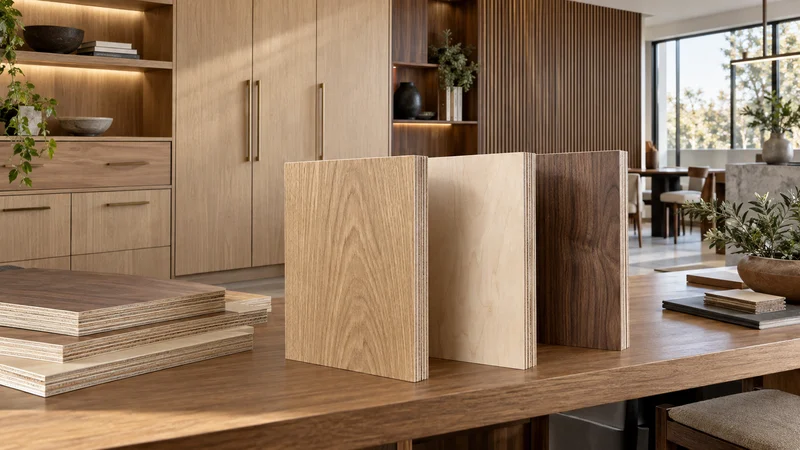
The face species determines the panel’s visual character, but a species name alone is not a complete specification. Confirm whether the veneer is natural or engineered, whether sapwood is allowed, whether heartwood color variation is acceptable and whether the order requires a particular regional or botanical source. Reference samples are especially valuable when color and grain are important.
خشب رقائقي من خشب البلوط الأبيض is often selected for pronounced grain and contemporary rift- or quarter-cut designs. خشب القيقب الرقائقي is commonly specified when a lighter, more uniform surface is desired. Walnut may be chosen for richer color and book-matched decorative work, while Red Oak, Ash and Cherry each create a different grain and color profile. Because appearance varies by species, the RFQ should define the required color range, grain character and acceptable natural variation.
For appearance-sensitive orders, buyers can describe the requirement in the RFQ as follows: Natural American White Oak face with controlled sapwood, an approved color range, quarter-sliced veneer, and a signed physical reference sample for production control.
2 Define the Face Grade
Common decorative face grades include AA, A, B and C, but the meaning of each grade depends on the referenced standard, species, cut and supplier’s grading rules. Buyers should not rely on the grade letter alone. Review Voyage’s overview of hardwood plywood face grades and require the quotation to state the grading standard and accepted edition.
For North American trade, ANSI/HPVA HP-1 is a widely used reference for hardwood and decorative plywood. Other destinations or applications may use different product, bond, structural, fire, emission or labeling requirements. Confirm the rules that apply in the destination market instead of treating one grading system as universal.
- AA or A faces may be appropriate for exposed premium surfaces where color, grain and defect limits are tightly controlled.
- B faces may suit visible applications that accept more natural variation or will receive an opaque finish.
- C faces may be suitable for utility, concealed or cost-sensitive applications, depending on the agreed standard and sample.
The safest order combines a written grade specification with an approved control sample, clear defect limits and an agreed procedure for borderline panels.
3 Select the Veneer Cut
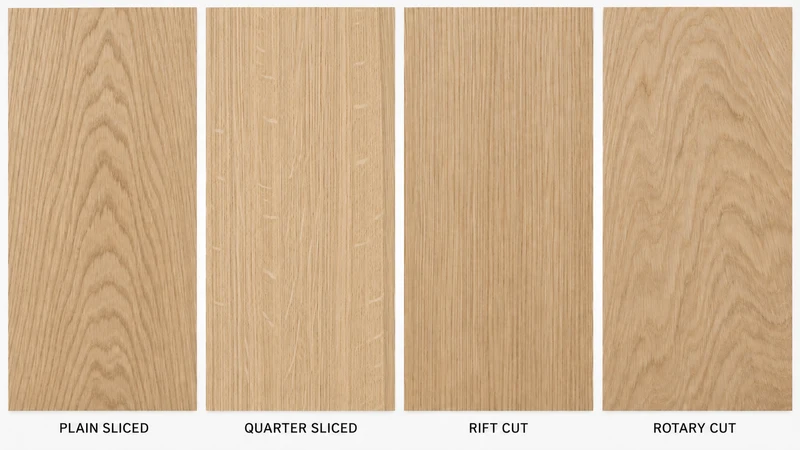
Veneer cut controls the grain pattern and can materially affect price and availability. It should be stated separately from the species and face grade.
- Plain sliced produces cathedral patterns and is often used for Red Oak, Walnut, Cherry and many traditional furniture designs.
- Quarter sliced produces straighter grain and may reveal ray fleck in species such as White Oak.
- Rift cut creates a controlled linear appearance and is frequently specified for contemporary White Oak work, usually at a higher cost and lower veneer yield.
- Rotary cut can provide broad, continuous sheets with varied grain and efficient material utilization; it is common in many Maple and utility applications.
If the cut matters visually, include photographs or a signed sample and define whether minor variation between sheets is acceptable.
4 Confirm the Veneer Matching Method
Matching describes how individual veneer leaves are arranged across the face. Book matching mirrors adjacent leaves and can create a balanced pattern, although alternating leaves may reflect light differently. Slip matching repeats grain in the same direction and often produces a more even color impression. Random matching emphasizes natural variation. Whole-piece faces minimize joint lines when available, while plank matching creates a deliberately varied solid-wood look.
Also state whether the face requires running match, balance match or center match. These terms affect component width, edge symmetry, material recovery and cost. Ask the supplier to show the proposed layup before mass production when continuity across multiple panels is important.
5 Set Face Veneer Component Width
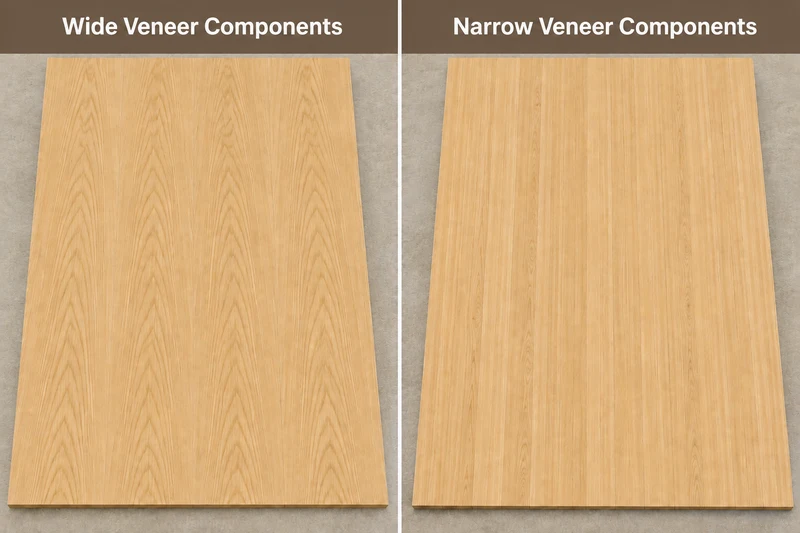
The width of individual veneer components used to assemble the face can affect visual continuity, the number of joint lines, grain consistency, material utilization and final cost. Component-width requirements may vary by wood species, veneer cut and face grade.
The following table shows the ANSI/HPVA HP-1 reference requirements applicable to White Oak face veneers. Buyers specifying Maple, Walnut, Ash, Cherry or other hardwood species should confirm the applicable requirements separately.
Minimum Face Veneer Component Widths for White Oak
| Veneer Cut | AA | أ | ب | C |
| Plain Sliced | 152 mm 6 in | 127 mm 5 in | 76 mm 3 in | No limit |
| Quarter or Rift | 76 mm 3 in | 76 mm 3 in | 76 mm 3 in | No limit |
| Rotary | 152 mm 6 in | 127 mm 5 in | 102 mm 4 in | No limit |
White Oak reference only, based on ANSI/HPVA HP-1-2024. Confirm the applicable species, veneer cut, face grade and any buyer-specific width requirement in the RFQ or purchase order.
6 Specify Face Veneer Thickness
Face veneer thickness affects sanding allowance, surface preparation, defect risk and cost. It should be expressed as a measurable requirement and tied to the stage of production. A nominal sliced-veneer thickness before pressing is not the same as the remaining face thickness after pressing and sanding. Ask the supplier which measurement the quotation uses and what tolerance applies.
A thicker face veneer can provide more sanding allowance during manufacturing and greater flexibility for surface preparation or minor repair, depending on the specified veneer thickness and finishing system. Thin faces may be appropriate for controlled factory finishing, but aggressive sanding can expose the glue line or core. Avoid assuming a universal decorative-face thickness; select it for the application, surface treatment and agreed quality level.
7 Choose the Core Construction
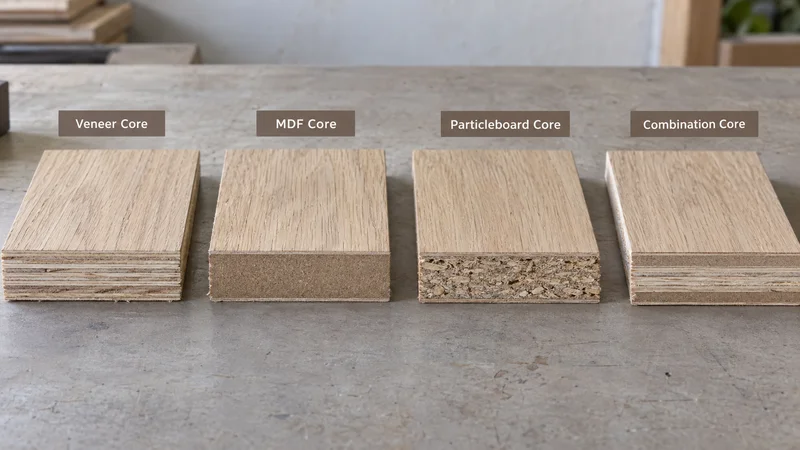
Core construction influences weight, screw holding, flatness, machining, edge appearance, moisture response and price. Common options include veneer core, MDF core, particleboard core and combination core. Each can be suitable when correctly matched to the application.
- Veneer core provides a favorable strength-to-weight ratio and is widely used for cabinets, furniture and general joinery.
- MDF core offers a smooth, consistent surface and clean machining for doors and routed components, but it is heavier and must be protected from unsuitable moisture exposure.
- Particleboard core can be economical and dimensionally consistent for interior furniture, with performance dependent on density, fasteners and edge treatment.
- Combination core typically combines a veneer inner core with thin MDF crossbands directly beneath the face and back veneers, improving surface smoothness while retaining much of the strength-to-weight advantage of veneer core.
For veneer-core panels, also specify the number of plies, permitted species or density range, core-gap and overlap limits, repairs, telegraphing acceptance and whether void-free edges are required. A quotation that states only ‘eucalyptus core’ or ‘hardwood core’ is incomplete.
8 Confirm Finished Thickness and Tolerance
Nominal thickness is a commercial description, not always the exact finished measurement. State the target finished thickness, acceptable positive and negative tolerance, measurement method and whether sanding or calibration occurs before shipment. This is critical when panels must fit grooves, hardware, automated machining or mixed-material assemblies.
If the order contains several thicknesses, list the requirement for each SKU. During sample approval and pre-shipment inspection, measure panels at agreed positions rather than relying on a single edge reading.
9 Define the Back Grade and Construction Balance
The back veneer is not merely cosmetic. Its species, grade, thickness and grain direction can influence balance, flatness and finishing. Define whether the back is exposed, semi-exposed or concealed, then specify an appropriate grade and allowable repairs.
For one-sided decorative panels, confirm how the construction is balanced and how panels should be stored and conditioned. If both sides will be visible, specify two decorative faces or a matched two-sided construction instead of assuming the supplier will infer the requirement.
10 Match the Bond and Moisture Performance
Interior, moisture-resistant and exterior bond descriptions are not interchangeable, and similar marketing terms may refer to different test methods. State the service environment and require the supplier to identify the adhesive system, bond classification, referenced standard and test evidence. Decorative hardwood plywood intended for dry cabinetry should not automatically be described as exterior or marine plywood.
Moisture content at shipment also matters. Agree on the acceptable range, conditioning method and sampling plan, taking the destination climate and packaging into account. Proper storage after arrival remains the buyer’s responsibility: panels should be kept flat, dry and acclimated before machining or finishing.
11 Verify Emissions and Responsible Sourcing
Emission compliance and responsible sourcing are separate requirements and should be documented separately. For U.S.-bound products, regulated composite wood panels and finished goods containing them must meet applicable EPA TSCA Title VI requirements. Products supplied to California must also meet applicable CARB ATCM requirements. Confirm the regulated core material, producer details, labeling, chain of custody for documentation and the records that will accompany the shipment.
For other markets, identify destination-specific formaldehyde, chemical, timber legality and labeling obligations before ordering. If FSC-certified material is required, state the exact FSC claim and require valid scope and transaction documents; an environmental claim should not be inferred from an emissions certificate.
Voyage can provide FSC-certified material options and, for specified product constructions, CARB Phase 2 and EPA TSCA Title VI compliance documentation. Certificate scope, producer identity, labeling and shipment documents are confirmed before order approval. Buyers can اتصل بـ Voyage to confirm the documentation available for a specific construction and destination.
12 Approve Samples Quality Control and Packaging
A sample is useful only when it represents the production specification. Mark the approved sample with the date, product code and agreed limits for color, grain, repairs, sanding, thickness, core and back. If natural variation is expected, approve a range rather than a single perfect panel.
The purchase order should also define the inspection method, sampling level, measurement tools, acceptance criteria and remedy for nonconforming goods. Production photographs can support communication but should not replace measurable inspection. For high-value or repeated orders, use a retained control sample and record results by batch.
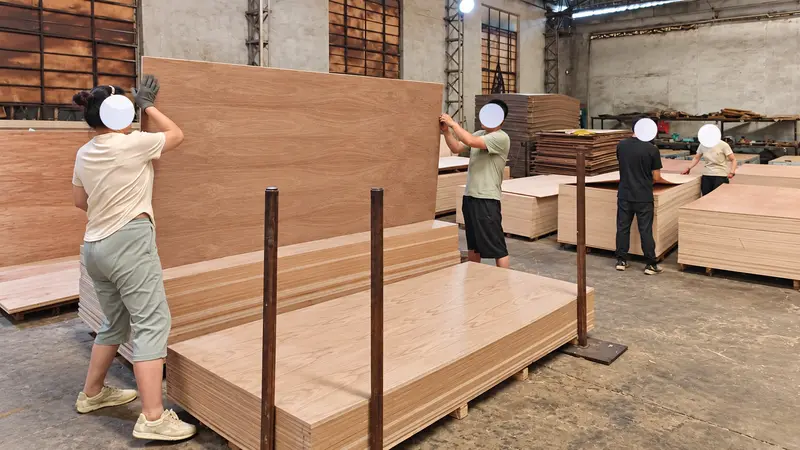
Export packaging must protect faces, edges and panel flatness during handling and container transport. Confirm protective film or paper, corner and edge guards, pallet construction, strapping, moisture barriers, package height, gross weight, labels and loading plan. Packaging should match the route, unloading equipment and storage conditions at destination.