Laminate Flooring Underlayment Explained: How B2B Buyers Should Choose the Right Type, Thickness and Performance
November 26, 2026
Laminate flooring buyers often compare designs, wear ratings, core density, thickness and click-lock systems. However, they can overlook the underlayment.
Underlayment sits between the subfloor and the laminate planks. Even though you cannot see it after installation, it can affect impact sound, walking comfort, moisture control, heat transfer and the long-term stability of the locking joints.
For importers, distributors and project buyers, price and material are only two parts of the decision.
To narrow your options, check the following factors:
- The construction and installation requirements of the laminate flooring.
- The type and condition of the subfloor.
- The intended application and expected traffic.
- Moisture and acoustic requirements.
- Compatibility with the flooring’s locking system.
- Technical performance verified through appropriate testing.
Use this guide to compare underlayment options and write a specification before requesting quotes.
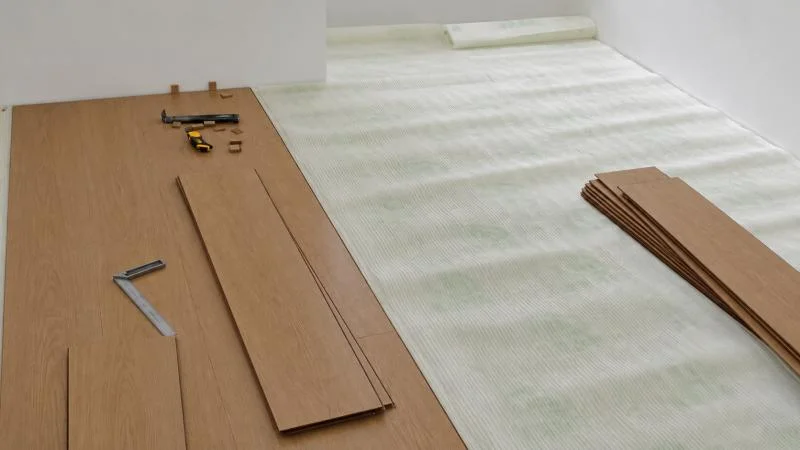
1. Why Does Underlayment Matter in a Laminate Flooring System?
Installers commonly lay laminate as a floating floor. The planks lock together and rest on the subfloor without permanent fasteners.
Underlayment sits beneath those planks. It can serve four functions:
1.1 Supporting the Flooring System
A suitable underlayment supports the planks evenly. It can also accommodate minor surface irregularities within the flooring manufacturer’s limits.
However, underlayment cannot fix a seriously uneven subfloor. Correct major surface defects before installation.
1.2 Managing Impact and Walking Sound
When people walk across a floating floor, the floor structure can generate impact noise and reflected walking sound.
A suitable underlayment may reduce both types of sound. However, the result depends on the underlayment, the flooring, the subfloor and the test conditions.
1.3 Providing Moisture Protection
On certain mineral subfloors, such as concrete, water vapor can migrate from the substrate toward the flooring.
A vapor-control layer may reduce this risk. However, some underlayments do not include one, and the installation requirements vary.
1.4 Supporting Thermal Performance
For installations over underfloor heating, the thermal resistance of the complete flooring assembly is important.
An underlayment with high thermal resistance can slow heat transfer. Therefore, compare the total thermal resistance of the flooring and underlayment. The thickness of the underlayment alone does not tell you how well heat will pass through.
For these reasons, choose underlayment as part of the complete flooring system.
2. A Six-Step Method for Choosing the Right Underlayment
Before comparing materials or requesting quotations, buyers should establish the project requirements.
- Check the flooring construction. Determine whether the laminate flooring has an attached underlayment or requires a separate layer.
- Identify the subfloor. Confirm whether the installation surface is concrete, cement screed, wood or another substrate.
- Define project priorities. Identify whether moisture protection, impact sound, durability, comfort or heat transfer is most important.
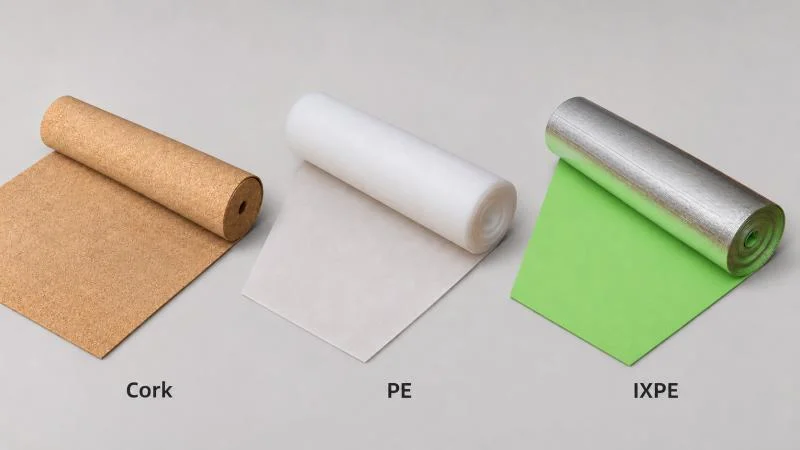
- Select a suitable material structure. Compare PE foam, IXPE, EVA, cork and other options against the required performance.
- Verify thickness and technical performance. Check compression, long-term deformation, dynamic loading, thermal resistance and other relevant data.
- Confirm compatibility and approve samples. Obtain the flooring manufacturer’s installation requirements and verify the proposed combination before bulk purchasing.
Follow these steps before comparing prices. Otherwise, a familiar material or a lower quote may lead you to an option that does not suit the floor.
3. Comparing Different Types of Laminate Flooring Underlayment
There is no single underlayment material that is best for every project. Different materials have different structures, costs and performance characteristics.
Use the comparison below to narrow your options. Then confirm performance with technical data for the specific product.
3.1 PE Foam Underlayment
Flooring suppliers commonly offer polyethylene (PE) foam underlayment.
Potential advantages:
- Generally economical.
- Lightweight and easy to handle.
- Available in different thicknesses and roll formats.
- Suppliers can pair it with a separate film or add a laminated moisture barrier.
Limitations to investigate:
- Performance varies with foam density and cell structure.
- Low-cost products may have limited resistance to repeated compression.
- Do not count on basic PE foam to act as a moisture barrier.
Consider PE foam for standard residential projects. First, confirm that it meets the flooring manufacturer’s requirements and any project limits for sound and loads.
3.2 IXPE Underlayment
IXPE stands for irradiated cross-linked polyethylene. Cross-linking changes the polymer structure and can influence its mechanical and physical properties.
Potential advantages:
- Can offer a consistent closed-cell foam structure.
- Available in relatively thin configurations.
- Manufacturers can tailor it to different flooring specifications.
- Some products also include a laminated film or another functional layer.
Limitations to investigate:
- Cross-linking alone does not prove that a product has superior long-term performance.
- Density, thickness, compression behavior and manufacturing quality still matter.
- Therefore, check the data for each IXPE product before treating two options as equivalent.
Consider IXPE when a residential or selected commercial project calls for a thin foam. Then check whether the specific product meets the required performance.
3.3 EVA Underlayment
Suppliers use ethylene-vinyl acetate (EVA) foam in cushioning products and some flooring underlayments.
Potential advantages:
- Manufacturers offer EVA foam in different densities and hardness levels.
- Offers flexibility in product design.
- May be available in different thicknesses and laminated structures.
Limitations to investigate:
- Performance depends heavily on formulation and manufacturing.
- Buyers should request compression and long-term stability data.
- Material identification alone is not enough to establish suitability.
Consider EVA if the supplier can show that the product meets the mechanical and installation requirements.
3.4 Cork Underlayment
Some flooring systems use cork, a natural material.
Potential advantages:
- Natural material composition.
- Cork may suit projects that prioritize sound control or walking comfort.
- Available in sheets and rolls.
Limitations to investigate:
- Check how the product responds to moisture and whether it maintains its dimensions.
- Product thickness and density affect performance.
- Buyers should confirm compatibility with the flooring system and installation environment.
Consider cork when a project calls for a natural material. In addition, confirm its technical performance and installation requirements.
3.5 How Should Buyers Compare These Materials?
Do not rank materials using a simple list such as “IXPE is always better than PE” or “cork is always quieter.” Instead, compare actual products using the same performance criteria.
| Comparison Factor | What Buyers Should Request |
| Material structure | Material type, construction and product specification |
| Thickness | Nominal thickness and manufacturing tolerance |
| Compression | Compressive strength and test conditions |
| Long-term stability | Compressive creep and dynamic load resistance |
| Acoustic performance | Test method, floor assembly and measured result |
| Moisture protection | Water vapor resistance or relevant barrier specification |
| Thermal performance | Thermal resistance value |
| Product consistency | Batch specifications and quality-control records |
4. How Thick Should Laminate Flooring Underlayment Be?
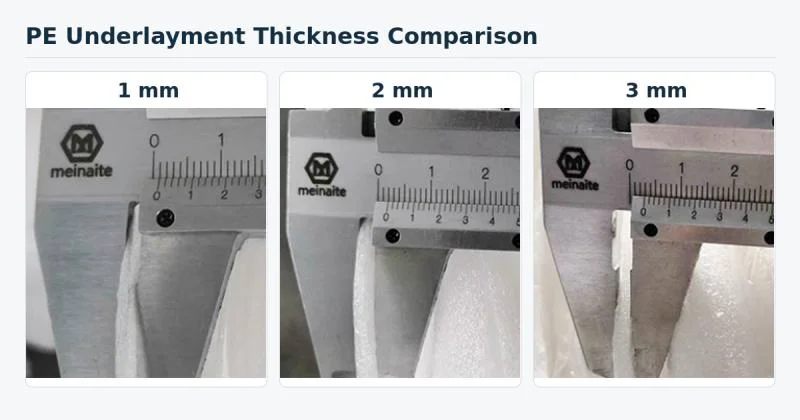
Thickness is one of the first specifications buyers ask about. Common market discussions include 1 mm, 1.5 mm, 2 mm, 3 mm and thicker products.
However, a larger number does not guarantee a better fit.
4.1 General Thickness Reference
The following table illustrates common thickness ranges found in the market. It is not a universal installation recommendation.
| Thickness | Typical Procurement Consideration | Important Checks |
| 1–1.5 mm | Thin-profile systems and installations with strict height requirements | Compression, compatibility and dimensional consistency |
| 2 mm | A common specification to evaluate for standard flooring systems | Compressive strength, dynamic load and moisture requirements |
| 3 mm | Projects where a thicker cushioning layer is being considered | Locking-system compatibility and long-term compression |
| 5 mm or above | Specialized products or specific flooring systems | Explicit manufacturer approval and supporting test data |
4.2 Why Is Thicker Not Always Better?
A thicker underlayment may feel more cushioned at first. However, a mat that is too soft or compresses too much can create problems.
For floating laminate flooring, the locking joints connect individual planks and help maintain the integrity of the floor surface.
If the underlayment compresses excessively under furniture, foot traffic or rolling loads, the flooring may experience additional movement.
Potential consequences include:
- Increased vertical movement between connected planks.
- Additional stress on locking joints.
- Changes in joint alignment.
- In unfavorable conditions, possible joint opening, edge damage or locking failure.
A thicker mat can still work. The key is to compare thickness with compression data and long-term performance.
4.3 Three Questions to Ask Before Choosing Thickness
- What thickness does the laminate flooring manufacturer recommend or permit?
- Does the underlayment meet the required compression and dynamic load performance?
- What evidence shows that the flooring and underlayment work together for the intended use?
For B2B buyers, the flooring manufacturer’s installation instructions should take priority over a supplier’s general recommendation. For plank specifications, see our laminate flooring thickness guide.
5. How to Choose Underlayment Based on the Subfloor and Project
The installation environment often determines which properties deserve the greatest attention.
5.1 Concrete and Cement Subfloors
Concrete and cement-based substrates may retain or transmit moisture.
For example, before specifying underlayment over a concrete slab, check:
- Has the installer or test provider checked the subfloor for moisture?
- Do the installation instructions call for a separate vapor-control layer?
- Does the underlayment already include a moisture barrier?
- How do the installation instructions say to seal seams and joints?
An important distinction: an underlayment with a foam layer is not automatically a moisture barrier.
If the project requires moisture protection, ask for water vapor resistance data or the specified barrier performance. Also confirm how to install the layer.
A vapor barrier does not replace proper substrate moisture testing or remediation. For the flooring itself, see our waterproof laminate flooring checks.
5.2 Wooden Subfloors
Wooden subfloors have different moisture and structural characteristics from concrete.
Before choosing an underlayment, confirm that:
- The subfloor is structurally sound.
- The surface meets the applicable flatness requirement.
- The flooring manufacturer permits a separate underlayment, if you plan to use one.
- Any additional moisture-control layers suit the installation.
Do not copy the vapor barrier arrangement for concrete. Instead, check the wooden subfloor and the requirements for the complete flooring system.
5.3 Apartments and Multi-Family Housing
In apartments, sound transmission between floors can be an important project requirement.
However, buyers need to distinguish between different acoustic measurements:
- Impact sound insulation: how well the assembly limits noise from impacts that travel through the building.
- Reflected walking sound: the sound people hear in the same room when someone walks on the floor.
- Airborne sound insulation: how well the assembly limits sound, such as speech, that starts in the air and travels between spaces.
These measurements are not interchangeable.
For multi-family projects, ask for the test method, reference floor construction and measured result. In particular, check that the advertised decibel figure applies to an assembly comparable to yours.
5.4 Hotels and Commercial Projects
Commercial projects may involve more frequent foot traffic, furniture movement and rolling loads.
In these situations, procurement should place greater emphasis on:
- Compressive strength.
- Compressive creep resistance.
- Dynamic load resistance.
- Compatibility with the flooring’s locking system.
- Maintenance and replacement considerations.
A product selected primarily for softness or low initial cost may not be the most appropriate choice for a demanding commercial application. For offices, shops and hotels, see our commercial laminate flooring buying guide.
5.5 Underfloor Heating
For underfloor heating, the total thermal resistance of the flooring assembly is a critical consideration.
The relevant value is not simply the thickness of the underlayment. It is the combined thermal resistance of the flooring and all relevant layers.
Buyers should:
- Confirm that the flooring manufacturer approves the intended heating system.
- Request the thermal resistance value of the underlayment.
- Evaluate the combined thermal resistance of the flooring and underlayment.
- Check the temperature limitations and installation instructions of both products.
The practical selection rule: Choose an underlayment with verified thermal resistance that is compatible with the flooring and heating system.
Do not assume that a thicker underlayment will improve comfort in a heated-floor installation.
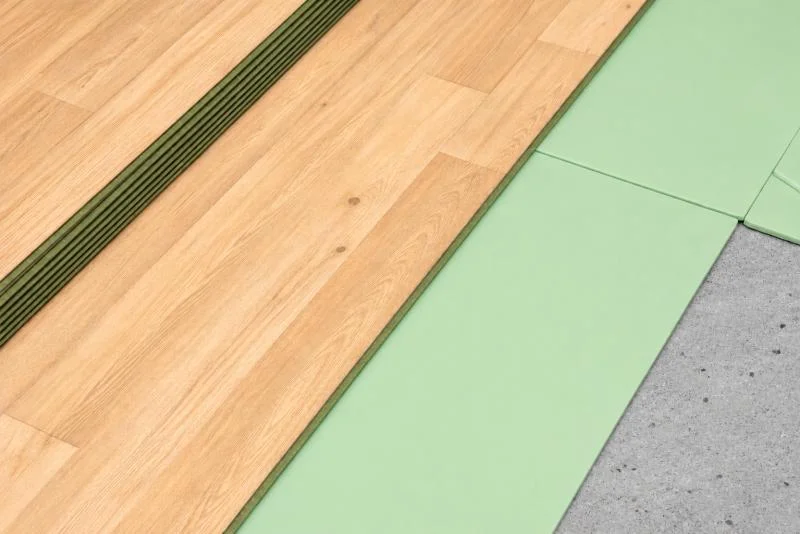
6. How to Evaluate Underlayment Technical Specifications
Use technical data to compare the products on your shortlist.
For example, a supplier may call an underlayment “high density,” “soundproof” or “waterproof.” These labels alone do not show whether it suits your project.
Instead, ask for measurable values and the test methods behind them.
6.1 Essential Technical Parameters
| Parameter | What It Tells You | Why It Matters |
| Thickness (mm) | Actual thickness under specified measurement conditions | Affects installation height and system compatibility |
| Thickness tolerance | Permitted variation from the declared thickness | Helps evaluate product consistency |
| Density (kg/m³) | Mass per unit volume | Supporting information, not a standalone quality indicator |
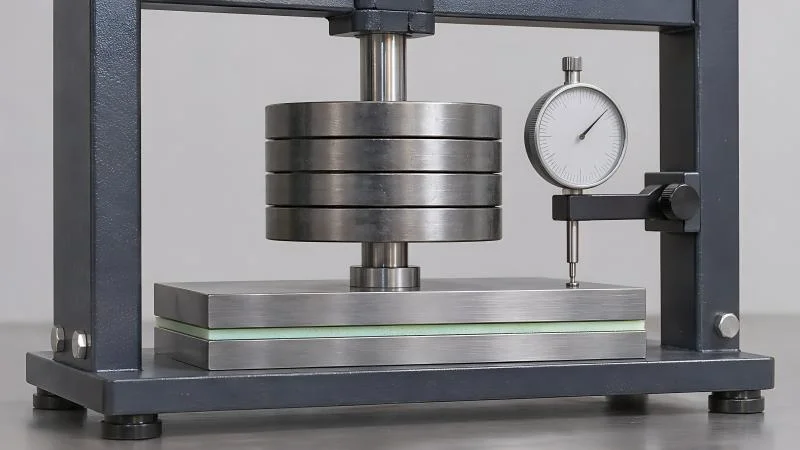
| Compressive Strength (CS) | Resistance to compression under specified conditions | Helps assess mechanical support |
| Compressive Creep (CC) | Resistance to long-term static compression | Relevant beneath furniture and sustained loads |
| Dynamic Load (DL) | Resistance to repeated loading under test conditions | Relevant to repeated foot traffic and rolling loads |
| Punctual Conformability (PC) | Ability to accommodate small local irregularities | Assesses limited local surface adaptation |
| Thermal Resistance (R) | Resistance to heat transfer | Important for underfloor heating |
| Water Vapor Resistance (SD) | Resistance to water vapor diffusion | Helps evaluate vapor control |
| Impact Sound Reduction | Result under a specified acoustic test arrangement | Useful for acoustic project comparison |
6.2 Why Density Alone Cannot Prove Quality
Consider two underlayments with the same declared density. They may still have different cell structures, polymer formulations, compression behavior, long-term deformation and manufacturing consistency.
Therefore, use density as one data point alongside the relevant performance results.
If two products have different densities, request their compression and long-term performance results before deciding which is more suitable.
6.3 How to Evaluate Acoustic Claims
Suppose Supplier A advertises an impact sound reduction of 18 dB, while Supplier B advertises 20 dB. It may appear that Supplier B has the better product.
But before comparing the figures, ask:
- Did the labs use the same test method?
- Did they use the same reference flooring?
- Did the labs use the same substrate and installation conditions?
- Do both figures report weighted impact sound reduction, or do they describe different measurements?
- Does each result describe the underlayment alone or the complete floor assembly?
Without comparable testing conditions, the two figures may not represent a fair comparison.
6.4 What Should a Proper Technical Data Sheet Include?
A professional supplier should be able to provide a technical data sheet containing:
- Product name and material construction.
- Declared thickness and tolerance.
- Width, length and roll or sheet format.
- Compression-related performance.
- Dynamic load performance, where relevant.
- Thermal resistance.
- Water vapor resistance, if applicable.
- Acoustic performance, if claimed.
- Test methods and test conditions.
- Installation and storage instructions.
For projects with formal specifications, ask for the underlying test report as well as the product data sheet.
7. How Does the Locking System Affect Underlayment Selection?
7.1 How Click-Lock Profiles Differ
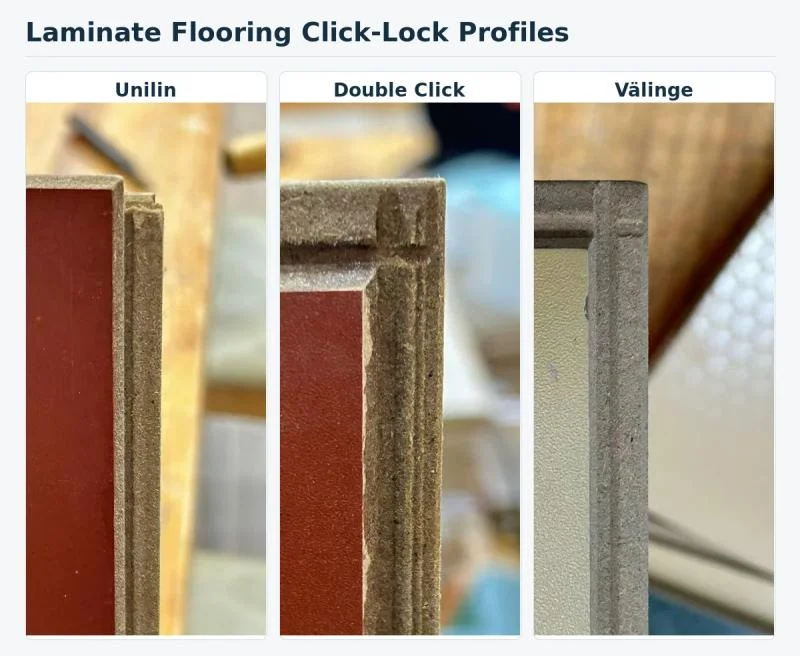
Click-lock profiles vary in shape and installation method. However, all of them need stable support beneath the planks.
| Common Locking System | Basic Installation Method | Underlayment Consideration |
| Angle-Angle Click | Planks are connected through an angled installation movement | Consistent support and controlled compression |
| Drop-Lock / 5G-Type | Typically combines angled long-side installation with a vertical drop-lock on the short side | Stable vertical support and resistance to excessive compression |
| Uniclic-Type | Uses a specially designed click profile for angled or approved push-down installation | Compatibility with the locking profile and long-term dimensional stability |
| Other Proprietary Click Profiles | Different manufacturers may use proprietary locking geometries | Follow the flooring manufacturer’s specified underlayment requirements |
7.2 What to Confirm Before Ordering
When comparing profiles, check how well the proposed underlayment supports the joints under load.
For example, a mat that is too thick, too soft or prone to long-term compression can let the planks move up and down. That movement can put more stress on the locking joints.
However, buyers should not assume that a particular locking system requires a specific underlayment material. The correct selection depends on the flooring construction, core properties, locking profile and manufacturer’s installation specifications.
Before placing bulk orders, buyers should confirm:
- Maximum permitted underlayment thickness.
- Required compression performance.
- Whether the flooring already has an attached pad.
- Whether the flooring manufacturer approves the proposed combination.
The key principle: Choose underlayment according to the complete flooring system, not simply the name of the locking technology. As an example, this 8 mm HDF laminate flooring specification lists click options. Confirm the exact profile and its underlayment requirements for your order.
8. Three Practical Procurement Scenarios
The following examples demonstrate how buyers can apply the selection method. If you buy for several markets, use our guide to specifying laminate flooring by market to set the project requirements first.
Scenario A: A Residential Flooring Order for Central Asia
Project requirements: An importer is sourcing 8 mm laminate for residential distribution. The buyer expects most installations to use concrete or cement-based subfloors.
Common purchasing mistake: The buyer requests a standard 2 mm foam underlayment simply because it is familiar and widely available.
Better selection process:
- Confirm whether the laminate flooring has an attached underlayment.
- Check the flooring manufacturer’s permitted underlayment thickness and compression requirements.
- Confirm the moisture-testing and vapor barrier requirements for concrete installations.
- Compare the proposed products using thickness, compression and moisture-related data.
- Approve a sample combination before ordering large quantities.
Procurement conclusion: A 2 mm product may be a suitable option, but only if it meets the flooring system’s requirements. The buyer should not treat 2 mm as a universal specification. For a real example of how to scope the supply package, see our Uzbekistan laminate flooring project, which included underlay and finishing profiles.
Scenario B: A Commercial Flooring Project in the Middle East
Project requirements: A buyer is sourcing flooring for a commercial interior where the floor may experience frequent use and furniture movement.
Common purchasing mistake: The buyer selects the thickest underlayment available, assuming that additional thickness will provide better comfort and sound performance.
Better selection process:
- Confirm the expected use and traffic conditions.
- Check the flooring manufacturer’s locking-system requirements.
- Compare compressive strength, compressive creep and dynamic load performance.
- Review the indoor temperature conditions and any relevant thermal or material limitations.
- If the project requires acoustic performance, ask for test results from a comparable floor assembly.
Procurement conclusion: Give priority to support and compatibility for this application. To assess any climate-related requirements, use the actual indoor conditions and the product’s test data.
Scenario C: A North American Multi-Family Housing Project
Project requirements: A project buyer needs laminate flooring for apartments and must consider sound transmission between units.
Common purchasing mistake: The buyer compares products only by their advertised decibel reduction and selects the highest number.
Better selection process:
- Obtain the project’s acoustic requirements.
- Identify the floor-ceiling assembly and substrate construction.
- Confirm which acoustic test method the project calls for.
- Request test reports showing the flooring and underlayment configuration.
- Check whether the complete system satisfies the project specification.
Procurement conclusion: Choose the underlayment that helps the complete floor assembly meet the acoustic specification. A higher advertised decibel figure alone does not settle the decision.
9. Integrated Underlayment or Separate Underlayment: Which Should Buyers Choose?
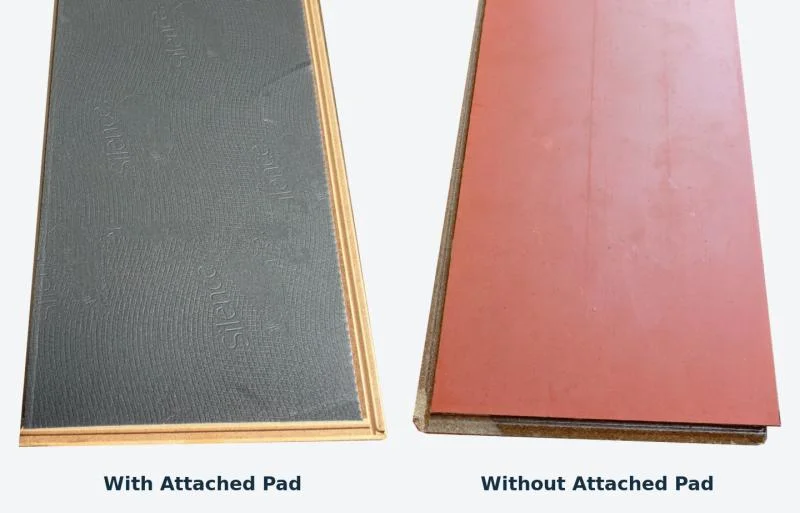
Some manufacturers attach underlayment to the back of each laminate plank. Other laminate products require a separate underlayment at installation.
| Factor | Attached Underlayment | Separate Underlayment |
| Installation | Fewer separate installation steps | Additional installation layer |
| Product Configuration | Supplied as part of the flooring product | Purchased separately |
| Specification | Performance must be evaluated as an integrated system | Buyers can specify a separate product |
| Inventory | Tied to the flooring product | Can be sourced and stocked separately |
| Compatibility | Designed as part of the flooring construction | Must be checked against flooring requirements |
When an Attached Pad Is Already on the Plank
Even with an attached pad, the flooring manufacturer may call for a separate vapor-control layer in some installations.
However, a vapor-control layer and a second cushioning layer serve different purposes.
Buyers should follow the flooring manufacturer’s written installation instructions. An unapproved double-underlayment arrangement can change the support conditions beneath the locking joints.
10. B2B Supplier Evaluation Checklist
Before approving an underlayment supplier, buyers should use a consistent checklist.
Product Identification
- Material and product construction clearly identified.
- Thickness, width, length and tolerance declared.
- Roll or sheet packaging specification confirmed.
Technical Performance
- Compressive strength data provided.
- Compressive creep or long-term performance data reviewed.
- Dynamic load test information available where required.
- Thermal resistance confirmed for heated-floor projects.
- Water vapor resistance confirmed where moisture protection is required.
- Acoustic data supported by an identifiable test method.
Compatibility and Quality
- Written compatibility with the selected laminate flooring confirmed.
- Attached-pad or separate-underlay arrangement clarified.
- Installation instructions supplied.
- Sample combination reviewed and approved.
- Batch consistency and quality-control process discussed.
For larger orders, buyers should also agree on product identification, packaging, batch traceability and the procedure for handling non-conforming goods.
11. Frequently Asked Questions
Q1. What is the best underlayment for laminate flooring?
There is no universal best option. The correct product depends on the laminate flooring construction, subfloor, project requirements and manufacturer’s installation instructions.
Q2. Is 2 mm underlayment suitable for laminate flooring?
It is a common thickness to evaluate, but suitability depends on compression performance, locking-system compatibility and the specific flooring manufacturer’s requirements.
Q3. Does thicker underlayment provide better sound insulation?
Not necessarily. Acoustic performance depends on the material, construction, flooring assembly, substrate and test method. Thickness alone cannot predict the result.
Q4. Does laminate flooring underlayment need a moisture barrier?
Some installations over concrete or other mineral substrates require a vapor-control layer. First, check subfloor moisture and the flooring manufacturer’s instructions. Then verify whether the underlayment itself provides the specified vapor protection.
Q5. Can I install two layers of underlayment?
Do not do so unless the flooring manufacturer explicitly permits it. An additional soft layer can change the support conditions and may affect locking-joint performance.
Q6. Which underlayment is suitable for underfloor heating?
Choose a product with verified thermal resistance that is compatible with the complete flooring and heating system. Evaluate the combined thermal resistance rather than the underlayment alone.
Q7. What is the difference between impact sound reduction and walking sound?
Impact sound travels through the building structure. In contrast, reflected walking sound is what people hear in the same room as they walk. Compare products using the same type of measurement.
Conclusion: Choose Underlayment by Performance, Not Just Price or Thickness
Start with the flooring and subfloor. Then identify what the project needs most: load support, moisture control, sound reduction or heat transfer.
Once you know those priorities, compare products using technical data from relevant, comparable tests.
Before placing a bulk order, buyers should confirm:
- Whether the planks already have a pad or need separate underlayment.
- Which underlayment thicknesses the flooring manufacturer permits.
- Whether the mat meets compression and long-term load requirements.
- How the proposed system meets moisture and thermal requirements.
- Which comparable tests support the acoustic claims.
- Whether the flooring manufacturer approves the complete combination.
Taking these steps makes supplier quotes easier to compare and can reduce installation problems.
If you’re still comparing flooring options, follow Voyage on Facebook for more flooring updates.
Looking for laminate flooring solutions for your distribution or project requirements?
Contact Voyage to discuss product specifications, available flooring constructions and sample arrangements.