Prefinished vs Unfinished Maple Plywood for Cabinets
October 22, 2026
A purchasing guide for cabinet manufacturers and plywood distributors
For cabinet manufacturers, importers and distributors, the choice between prefinished and unfinished maple plywood comes down to a practical question: how much finishing work do you want to do after the panels arrive? The answer affects your labor, production time and final cabinet appearance.
Choose prefinished maple plywood when the factory finish matches your needs and lets you skip finishing the coated faces in your shop. Choose unfinished maple plywood when you want to apply your own stain or paint, or match other cabinet parts. With either option, check the veneer grade, core, actual thickness and finish on each side before ordering.
What is the difference between prefinished and unfinished maple plywood
Prefinished maple plywood arrives with a factory-applied coating on one or both faces, as ordered. A clear UV-cured finish is a common choice for showing the natural maple grain. You can cut and assemble the panel without applying another finish to the already coated faces.
Unfinished maple plywood arrives without the final decorative coating. Your shop handles the sanding, staining or painting needed for the project. Both types still need any cutting, drilling, edge banding and assembly required by the cabinet design.
| Buying consideration | Prefinished maple plywood | Unfinished maple plywood |
| Surface finish | Factory coating approved before ordering | Your shop applies the final finish |
| Work after delivery | Cut, drill, edge band and assemble as needed | Prepare and finish the faces, plus normal fabrication |
| Custom colors | Choose an available finish or agree a custom option | Apply your own stain or paint |
| Costs to compare | Panel price, machining, handling and rework | Panel price plus shop finishing and normal fabrication |
| Common uses | Clear-finished cabinet interiors, shelves and parts | Parts needing custom colors or a matching shop finish |
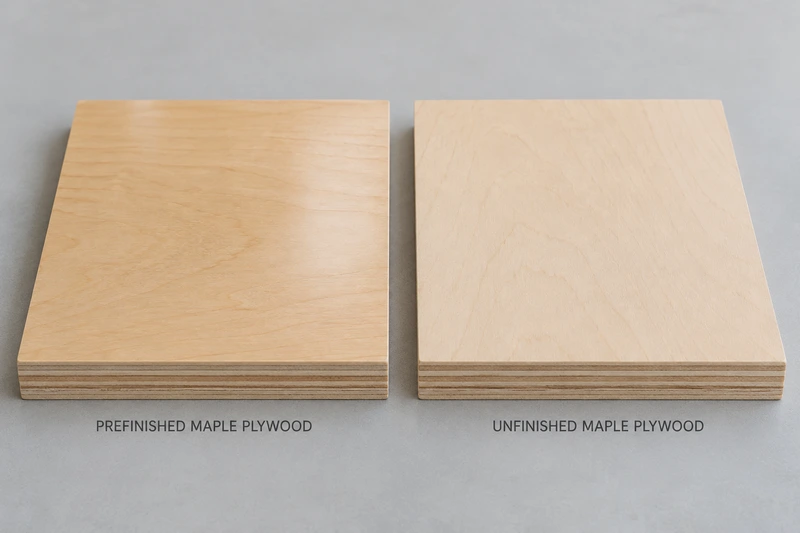
1 Choose the finish for each cabinet part
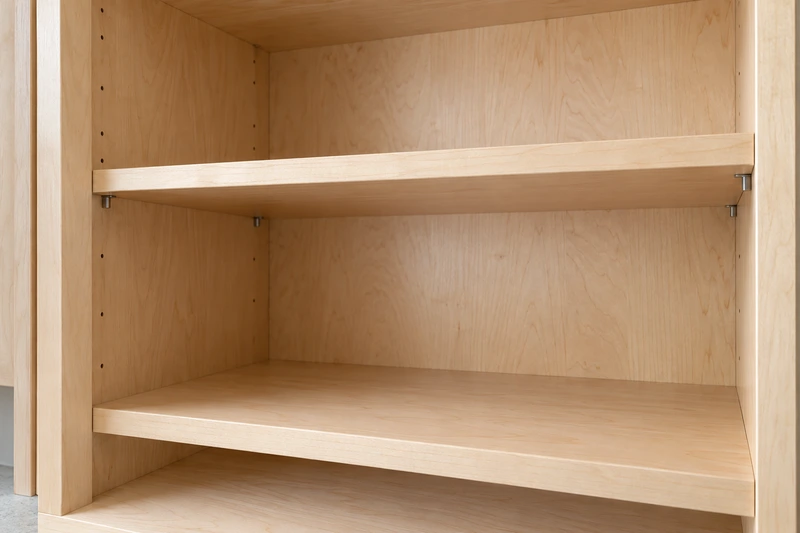
Start with where the panel will be used. Cabinet interiors, shelves and drawer parts may suit a clear factory finish. Visible doors and end panels may need a custom color to match the rest of the project.
Prefinished maple plywood works well for repeat orders when the factory color and sheen are already approved. Unfinished panels give your shop more control when matching doors, solid-wood trim or existing cabinetry. Natural color and grain variation will still be visible through a clear finish.
Also decide whether you need one finished side or two. A shelf visible from above and below may need a different finish arrangement from a cabinet side with one hidden face. Confirm the treatment on the reverse side and the panel flatness you need.
2 Compare the same veneer grade and core
Compare more than the coating. Two maple panels can look similar in a small photo but have different face grades, back grades, cores or veneer thicknesses. These details affect the appearance and how the board performs during cabinet production.
For example, an A-grade prefinished panel and a B-1 unfinished panel differ in more than their finish. To find out what prefinishing adds to the price, ask for both options with the same veneer selection, core, size and thickness.
Voyage offers prefinished maple plywood and unfinished B-1 maple plywood. Use these product pages as a starting point, then ask us to quote the grade and construction you need. Our hardwood plywood buying guide explains the other panel details worth comparing.
3 Compare the total cost of making the cabinet parts
Unfinished panels may cost less to buy, but you still need to pay for preparation, coatings, labor and drying or curing time. Prefinished panels may cost more per sheet while reducing work on the coated faces. Both options also involve cutting waste, handling and any rework.
For a fair comparison, estimate the full material and processing cost for the same batch of cabinet parts. Then divide it by the number of usable parts produced. This shows the cost of a finished part more clearly than the sheet price alone.
Prefinished panels are especially useful when finishing is slowing down your production. If you have spare finishing capacity and need several custom colors, unfinished panels may suit the job better. Compare both quotations at the same quantity and delivery terms.
4 Try cutting and edge banding a sample
Before a bulk order, check more than the color and grain. Try the work your cabinet design requires, such as cutting, drilling or edge banding. Look for chipped edges, damage to the coating and a poor color match between the face and edge banding. This helps you see whether the panel works with your current equipment and materials.
For unfinished panels, finish a sample using your planned sanding and coating process. For prefinished panels, check the factory finish alongside your edge banding and other cabinet parts. Keep the approved sample so both sides have a clear reference for the bulk order.
Ask for the actual panel thickness and tolerance in millimetres as well as any nominal inch size. Panels sold as 3/4 inch can have different actual thicknesses. Your grooves, hardware and edge banding need to fit the board you receive.
5 Agree on the color and finish you need
Ask what coating is used and whether it suits the cabinet application. UV refers to how a coating is cured; it does not mean every UV-finished panel has the same resistance to scratches, cleaners or moisture. Ask for relevant performance information if the project has specific requirements.
Compare samples under the same lighting. Matte and satin can look different from one supplier to another, so an approved sample gives everyone a clearer reference. If the project specifies a measured gloss level, include the value and measurement method in the order.
If you plan to add paint, stain or glue over a factory-coated face, check compatibility first. Your coating or adhesive supplier can explain any surface preparation needed. Try it on the actual panel before using it in production.
6 Protect the surface and keep repeat orders consistent
Agree how the finished faces will be protected during packing and shipping. Confirm pallet protection, stacking and whether suitable interleaving or protective film is needed. If film is used, ask when and how it should be removed.
For repeat orders, keep the approved sample with its panel and finish codes. Agree on the acceptable color and grain range and ask the supplier to flag changes in veneer selection or coating before production. This makes later orders easier to compare with the original sample.
7 Choose EPA and CARB compliant maple plywood
Voyage maple plywood complies with EPA TSCA Title VI and CARB Phase 2 formaldehyde emission requirements. These are important purchasing specifications for cabinet manufacturers and distributors serving the US market.
Include the required compliance documents and panel labeling in your order details, together with the chosen core, grade and finish. These requirements concern formaldehyde emissions; they do not describe scratch resistance or make the panel waterproof. For background, see the US EPA composite wood product guidance.
8 Consider Nigeria production for US orders
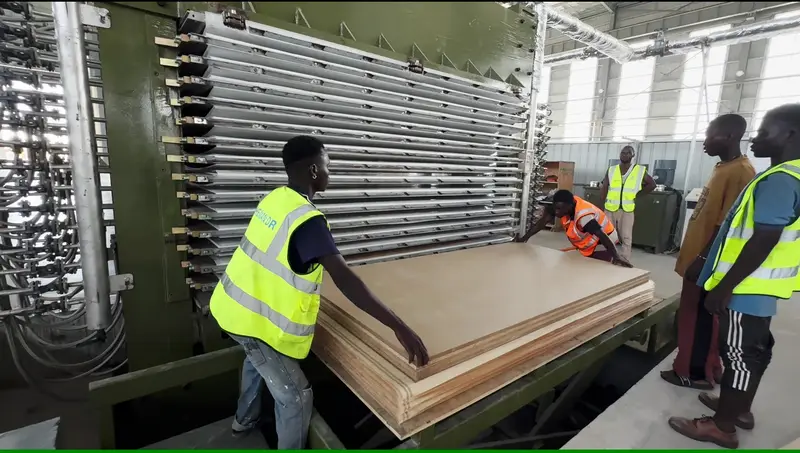
Voyage operates hardwood plywood production bases in China and Nigeria, giving US cabinet manufacturers, importers and distributors more flexibility when sourcing maple plywood. Our Nigeria factory provides an alternative production option for buyers looking to diversify supply and compare landed costs.
For qualifying Nigerian-origin products, this route can offer a cost advantage over imports subject to China-specific antidumping and countervailing duties.
Contact Voyage with your panel specifications, quantity and US destination to explore our Nigeria production options and request samples and a quotation.
What to send when requesting a maple plywood quote
- Cabinet application and, if available, part drawings showing the visible faces.
- Maple veneer selection, face and back grades, core, panel size, actual thickness and tolerance.
- Prefinished or unfinished supply; finished sides, target color and sheen, and edge-banding needs.
- Sample requirements and any specific coating performance requirements.
- Quantity, destination, preferred production location, delivery terms, packaging, and EPA TSCA Title VI or CARB Phase 2 documentation requirements.
Suggested RFQ wording
Please quote prefinished and unfinished maple plywood for our cabinet production. Use the same veneer selection and panel construction for both options. Please list the face and back grades, core, size, actual thickness and tolerance, coating and finished sides. Include sample options, packaging, lead time, EPA TSCA Title VI and CARB Phase 2 compliance documents, and prices for our quantity and destination.
Frequently asked questions
Is prefinished maple plywood better for cabinets
It can be a good choice for cabinet interiors, shelves and other parts that use the approved factory finish. Unfinished maple plywood is often more suitable when your shop needs a custom stain or paint finish.
Can prefinished maple plywood still be cut and drilled
Yes. Try the cutting and drilling needed for your cabinet parts, and check the edges for chipping or coating damage before starting a large batch.
Can unfinished maple plywood match a prefinished panel
A close match may be possible, but it needs a finished sample. The veneer color, coating and sheen all affect the result. Compare the samples together under the same lighting.
Does UV finished plywood mean waterproof plywood
No. A UV-cured coating on the face does not establish the water resistance of the core, exposed edges or joints. Ask for the panel performance needed for the intended use.
Is prefinished maple plywood always cheaper to use
No. It may reduce finishing work, but the result depends on the panel price, labor saved, cutting yield and rework. Compare the total cost of making the same usable cabinet parts.
Request maple plywood samples and a quote
Voyage supplies hardwood plywood for cabinets and interior woodwork, including prefinished and unfinished maple plywood that complies with EPA TSCA Title VI and CARB Phase 2 requirements. Tell us what you are making and the finish you want so we can help you compare suitable options. With production bases in China and Nigeria, we can also discuss the production location and shipping route for your US order.
Contact Voyage with your grade, core, thickness, size, finish, quantity and destination to request samples and a quotation. For US orders, mention your interest in Nigeria production so the quotation can identify the proposed manufacturing route.
Official references
US EPA formaldehyde emission standards for composite wood products.
US Customs and Border Protection guidance on antidumping and countervailing duties