U.S. Hardwood Plywood Sourcing in 2026: How Buyers Can Reduce Landed Risk and Protect Supply Continuity
August 28, 2026

A hardwood plywood quotation can look competitive and still become expensive if the shipment is delayed, the declared origin cannot be supported or repeat orders fail to match the approved sample. For a procurement manager, the real decision is not simply, “Who has the lowest FOB price?” It is, “Which supplier can deliver the specified panel, on schedule, with a document trail that can withstand review?”
This guide gives U.S. importers, distributors, cabinet manufacturers, furniture producers and architectural millwork companies a practical framework for comparing suppliers before issuing a purchase order. It focuses on the sourcing questions that most directly affect landed cost, inventory continuity and customer commitments: where the panel is manufactured, whether current trade measures may apply, whether product-compliance records match the actual producer and whether the supplier has a credible continuity plan.
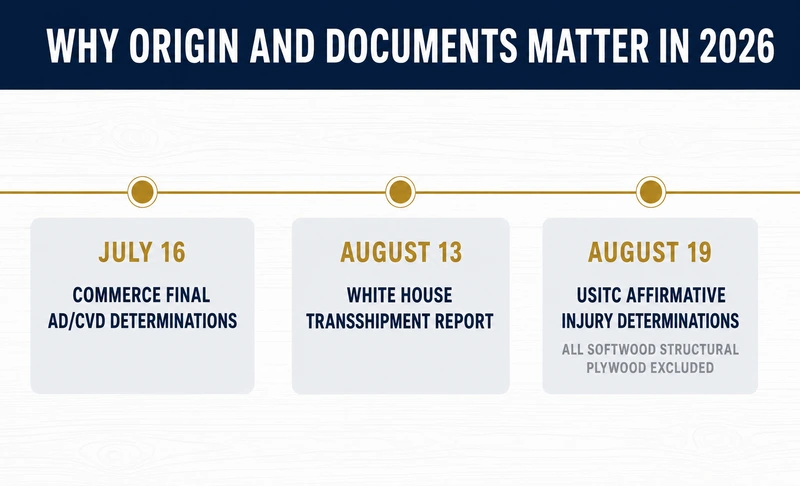
These questions became more urgent in 2026. On July 16, the U.S. Department of Commerce announced final affirmative AD/CVD determinations in investigations concerning hardwood and decorative plywood from China, Indonesia and Vietnam. On August 19, the U.S. International Trade Commission made affirmative injury determinations for hardwood and decorative plywood—excluding all softwood structural plywood—and stated that Commerce will issue AD/CVD orders. The White House also published a report on illegal transshipment and data-driven enforcement tools. For buyers, the practical response is simple: verify the factory, manufacturing steps and supporting records before production begins—not after a shipment is questioned. (Commerce final determinations; USITC announcement; White House report)
Voyage approaches this as a product-and-supply-planning issue rather than an origin-label exercise. For White Oak, Maple and other decorative hardwood plywood programs, the product specification, proposed production facility, sample standard, required documents and shipping plan are reviewed together. That is the buying process this article is designed to support.
1. Country of Export Is Not the Same as Customs Country of Origin
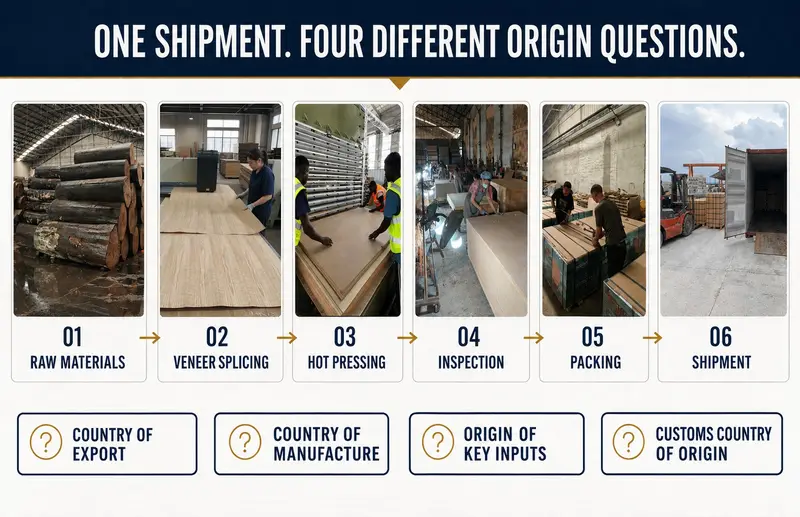
International plywood supply chains can involve timber or veneer from one country, core materials from another, manufacturing in a third location and export through a separate port. Those facts need to be separated rather than compressed into a single “origin” label.
- Country of export: The country from which the shipment is dispatched. This identifies the shipping route, not automatically the customs origin of the finished panel.
- Country of manufacture: The location where the panel is physically produced. Buyers should understand which production steps are actually performed at that facility.
- Origin of key inputs: The source of face veneers, core materials, resins or other major inputs. Input origin is important for traceability, but it does not by itself decide the origin of the finished product.
- Customs country of origin: The legal origin determined under the applicable customs rules. For many goods, U.S. Customs and Border Protection considers whether processing creates a new article with a different name, character or use, but the analysis is fact-specific. (CBP guidance)
Country-of-origin and AD/CVD scope decisions are fact-specific. A procurement team does not need to make the final legal determination alone, but it should collect the facts its broker or adviser will need: the bill of materials, manufacturing operations, facility identity, product classification and shipment records. A real factory in a second country is important evidence, but factory presence alone does not decide the duty treatment of every panel. Where uncertainty remains, a CBP binding ruling or advice from qualified customs counsel may be appropriate.
2. Why Traceability Has Become a Purchasing Requirement
The supply chain should tell one consistent story. Buyers and enforcement agencies can compare routing, product classifications, ownership relationships, production-capacity indicators and trade-flow patterns. A country name on an invoice or a stand-alone certificate is therefore not a strong file by itself.
A well-prepared supplier should be able to connect the commercial order with the actual factory, production records, product labels and shipping documents:
Purchase order → declared factory → production records → product labels → packing list → bill of lading → customs entry
For procurement managers, this is not only a customs issue. Documentation prepared before loading reduces broker back-and-forth, supports internal approval, makes repeat orders easier to manage and lowers the risk of a container sitting while basic facts are reconstructed.
3. What U.S. Buyers Should Verify Before Issuing a Purchase Order
Before approving a supplier or releasing a deposit, a practical sourcing review should answer the following questions:
- Where will this order actually be manufactured: Identify the facility, address and legal entity that will perform the production—not only the sales office or port of loading.
- Which production steps will occur there: Confirm veneer preparation, core assembly, lay-up, pressing, sanding, finishing, inspection and packing as applicable to the program.
- Where do the key inputs come from: Record the source of face veneers, core components, adhesives and other materials that may be relevant to origin or product compliance.
- Has the importer reviewed classification and AD/CVD scope: The HTS classification, order scope and cash-deposit requirements should be checked by the importer, broker or customs adviser using the current rules.
- Which origin records can be supplied: Ask for documents that support the declared manufacturing location and connect the product description across production and shipping records.
- Are emissions documents valid for the product and facility: Verify the EPA-recognized third-party certifier, mill or producer identity, product scope, label and supporting records where TSCA Title VI applies.
- How will quality be approved: Confirm the pre-production sample, veneer grade, cut and match, core construction, finished thickness, tolerance, flatness, finish and packaging standard.
- What is the contingency plan: If another factory may support the program, qualify that facility separately rather than assuming that the product, documents and duty treatment are interchangeable.
This sequence mirrors how Voyage evaluates a new inquiry: first define the panel and the quality benchmark, then match the program with a facility whose product capability, production schedule and documentation can support the destination market. The production location should follow the product and order requirements—not the other way around.
4. Check Product Compliance and Trade Documentation Separately
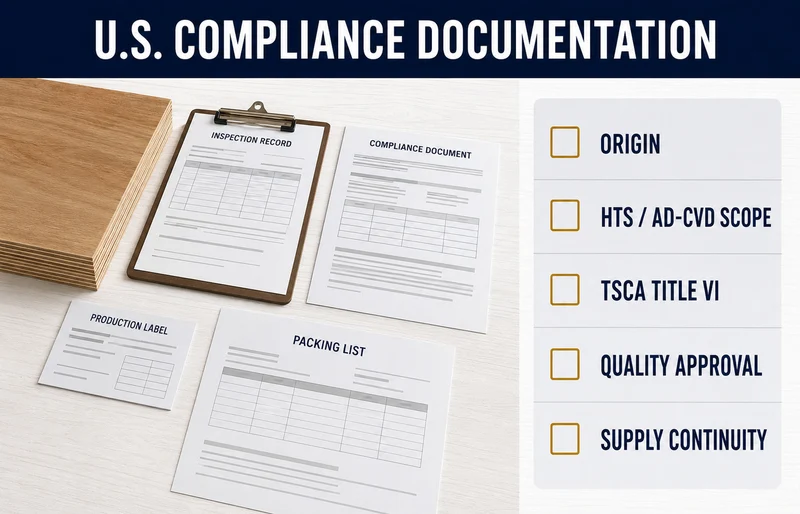
A panel can meet the approved technical specification and still have an incomplete import file. Accurate origin records, meanwhile, do not prove that the product meets U.S. formaldehyde-emission requirements. Buyers should keep these two checks separate and complete both before shipment.
Product compliance
EPA’s TSCA Title VI program covers regulated composite wood products including hardwood plywood, MDF and particleboard. For regulated products manufactured in or imported into the United States after March 22, 2019, the applicable products must be certified as compliant by an EPA-recognized TSCA Title VI third-party certifier and labeled as TSCA Title VI compliant. CARB Phase 2 remains relevant for products sold in California, but a CARB Phase 2 label alone does not replace the federal TSCA Title VI certification and labeling requirements after that date. (EPA rule summary)
Buyers should ask for documentation tied to the actual producer and product—not a generic marketing statement. The file should identify the certifier, mill or factory, covered product type, label language and the supporting test or quality-control records available for the shipment.
Trade compliance
Trade compliance addresses tariff classification, AD/CVD scope, country of origin, valuation and the consistency of commercial and production records. Commercial invoices, packing lists, bills of lading, factory records and product labels should describe the product and its origin consistently.
FSC certification, where requested, addresses responsible sourcing and chain of custody. It is valuable, but it is separate from TSCA emissions compliance and customs origin analysis.
5. Compare Risk-Adjusted Landed Cost, Not FOB Price Alone
A lower FOB quotation can be attractive, but it is only one line in the purchasing decision. Buyers should also compare applicable duties, the cost of documentation and review, logistics, quality consistency, schedule reliability and the supplier’s ability to keep the program running if conditions change.
If the declared origin cannot be supported, the importer may face additional document requests, clearance delays, cash-deposit or duty liabilities, storage and demurrage costs, inventory shortages and the expense of qualifying a replacement supplier. For a cabinet or furniture manufacturer operating on a fixed production schedule, those costs can quickly exceed the original material-price saving.
The better comparison is therefore risk-adjusted landed cost: what the panel will cost after duties, compliance work, logistics and disruption risk are considered—not simply which quotation is lowest on the day it is received.
6. Legitimate Multi-Origin Manufacturing Is Different From Illegal Transshipment
A diversified supply chain can be a responsible risk-management strategy, but only when the manufacturing facts and records support the declared origin. The distinction should be clear to both supplier and buyer.
| Illegal Transshipment / Origin Evasion | Documented Multi-Origin Manufacturing |
| Product is made in Country A and routed or lightly handled in Country B to obscure its actual origin. | Product is physically manufactured at the declared facility under an order-specific production plan. |
| The commercial objective is to conceal origin or evade duties and restrictions. | The commercial objective is to match genuine factory capability, specification, capacity and supply needs. |
| Production records, capacity evidence and shipment documents may be missing or inconsistent. | Factory capability, production records, quality-control evidence and shipment documents support one consistent account. |
| The importer may face inquiries, delays, additional liabilities or enforcement action. | A different origin may be supportable, but duty treatment still depends on the applicable legal scope and facts. |
Important: a legitimate second factory does not automatically guarantee a specific tariff result. The manufacturing process, materials, product scope and current U.S. measures must still be reviewed for each program.
7. How Voyage Turns Product Specifications Into a Documented Supply Plan
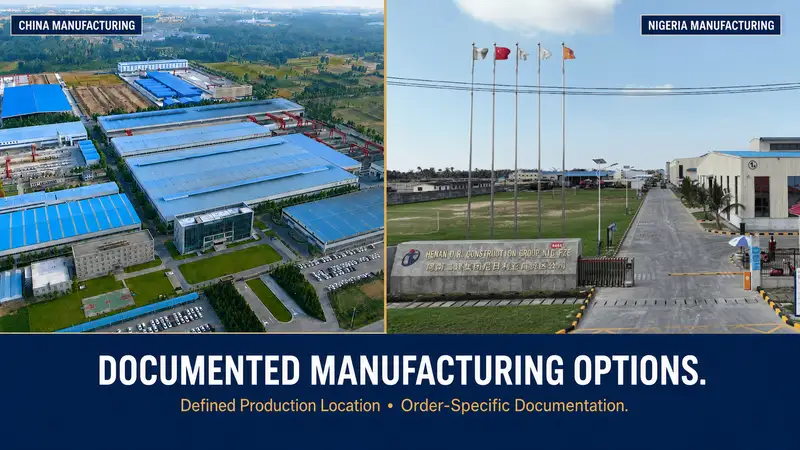
Voyage combines hardwood plywood production capabilities in China and Nigeria with U.S. service and warehousing presence through BSD HOUSE in Los Angeles. For a buyer, the benefit is not a generic “alternative origin” promise. It is the ability to discuss the panel construction, production location, sample standard, documentation and continuity plan in one sourcing conversation.
The China manufacturing base supports programs that require advanced veneer processing, custom specifications, decorative matching and product development. Voyage’s Nigeria program includes White Oak plywood and Maple plywood options with standard and customized dimensions. The appropriate facility is matched to the product specification, confirmed capability, order volume, schedule, destination and documentation requirements.
Voyage’s Nigeria factory holds EPA TSCA Title VI and CARB Phase 2 certificates covering specified hardwood plywood products.
An order-specific Voyage sourcing review can cover:
- Product and facility fit: The specification, packaging, factory, legal entity, confirmed capability and production schedule for the order.
- Sample and quality plan: A reference panel or sample set, inspection approach and order-specific quality records.
- Market documentation: Review of TSCA Title VI, CARB or FSC documentation, as applicable, for the specific product and facility.
- Continuity planning: A separately qualified production option when the specification, volume and trade conditions make it appropriate.
Before production, Voyage and the buyer should confirm the proposed facility and required supporting documents for the order. If a second facility may be used, it should be qualified as a separate manufacturing program rather than treated as an interchangeable shipping route.
Conclusion: Choose a Supplier That Can Protect the Product and the Schedule
For U.S. hardwood plywood buyers, the strongest supplier is not simply the one that can quote the requested panel. It is the one that can translate the specification into a repeatable production plan, support the declared manufacturing facts and help keep the buyer’s delivery schedule intact.
That combination—product capability, documented production, quality consistency and supply continuity—provides a more useful basis for a purchasing decision than price or country label alone.
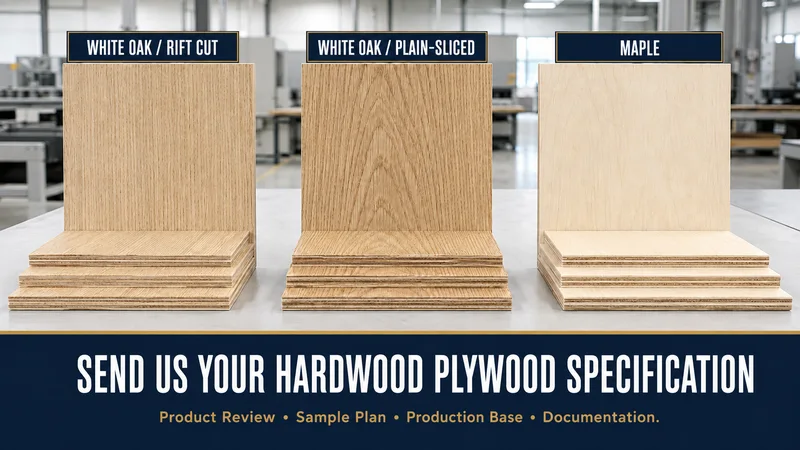
Send Voyage Your Specification for a Sourcing Review
To receive a practical recommendation, send the Voyage team:
- Product requirement: Species, veneer cut and grade, dimensions, thickness, core and finish.
- Market and commercial plan: Destination, required documents, trial quantity, expected annual volume and target delivery window.
- Quality reference and challenge: Photos, drawings, a sample or approval standard, plus the current cost, lead-time, consistency, documentation or continuity issue.
Voyage can then review product fit, propose a feasible production base, prepare a sample plan and outline the documents to confirm before quotation and shipment. Explore Voyage’s hardwood plywood programs or send your specification to request an order-specific sourcing review.
READY TO START? Send your plywood specification for an order-specific sourcing review.
Sources
- U.S. International Trade Commission: USITC Votes on Hardwood and Decorative Plywood from China, Indonesia, and Vietnam — August 19, 2026
- U.S. Department of Commerce: Final Affirmative AD/CVD Determinations — July 16, 2026
- The White House: The Great Transshipment Scam — August 13, 2026
- U.S. Customs and Border Protection: Marking of Country of Origin on U.S. Imports
- U.S. Environmental Protection Agency: Formaldehyde Emission Standards for Composite Wood Products